suppose that g(x) is a polynomial function, g(5)= -18, g(5)=0, and g(5)= -17. which of the following is…
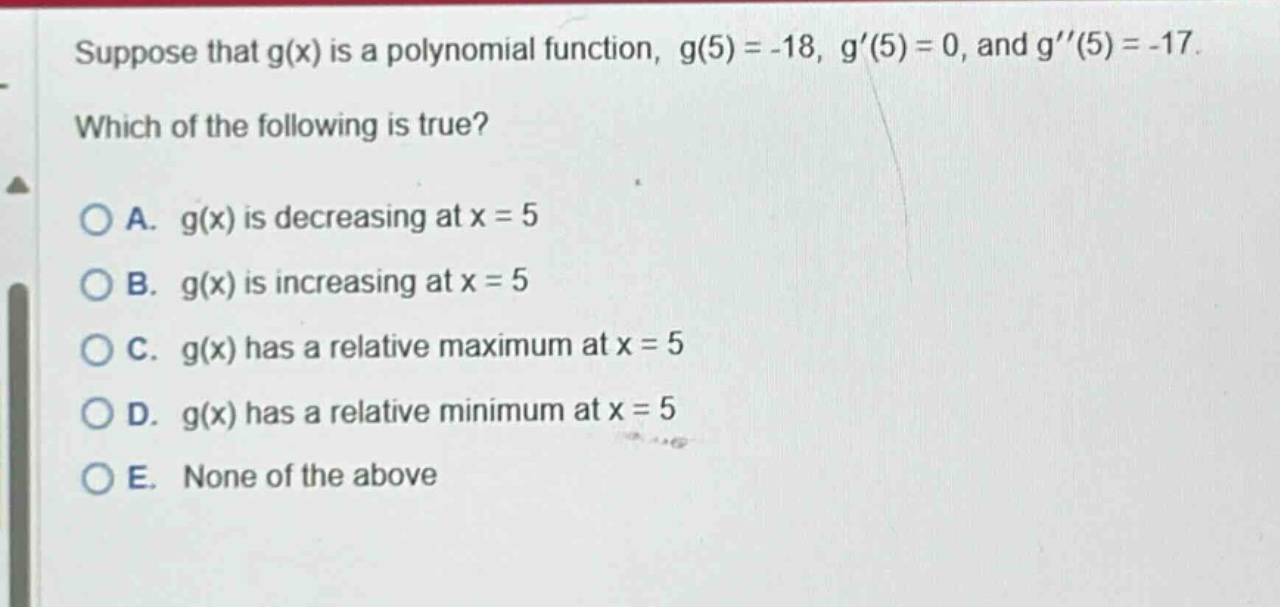
suppose that g(x) is a polynomial function, g(5)= -18, g(5)=0, and g(5)= -17. which of the following is true? a. g(x) is decreasing at x = 5 b. g(x) is increasing at x = 5 c. g(x) has a relative maximum at x = 5 d. g(x) has a relative minimum at x = 5 e. none of the above
Answer
Explanation:
Step1: Recall derivative - based function behavior rules
The first - derivative $g^{\prime}(x)$ determines if a function is increasing or decreasing. If $g^{\prime}(x)>0$, the function is increasing; if $g^{\prime}(x)<0$, the function is decreasing. Here, $g^{\prime}(5) = 0$, so the function is neither increasing nor decreasing at $x = 5$, eliminating options A and B.
Step2: Use the second - derivative test
The second - derivative test states that if $g^{\prime}(c)=0$ and $g^{\prime\prime}(c)<0$, then the function $g(x)$ has a relative maximum at $x = c$. Given $g^{\prime}(5)=0$ and $g^{\prime\prime}(5)=- 17<0$, the function $g(x)$ has a relative maximum at $x = 5$.
Answer:
C. g(x) has a relative maximum at x = 5