suppose a sphere of radius r is sliced by two horizontal planes h units apart as shown. show that the…
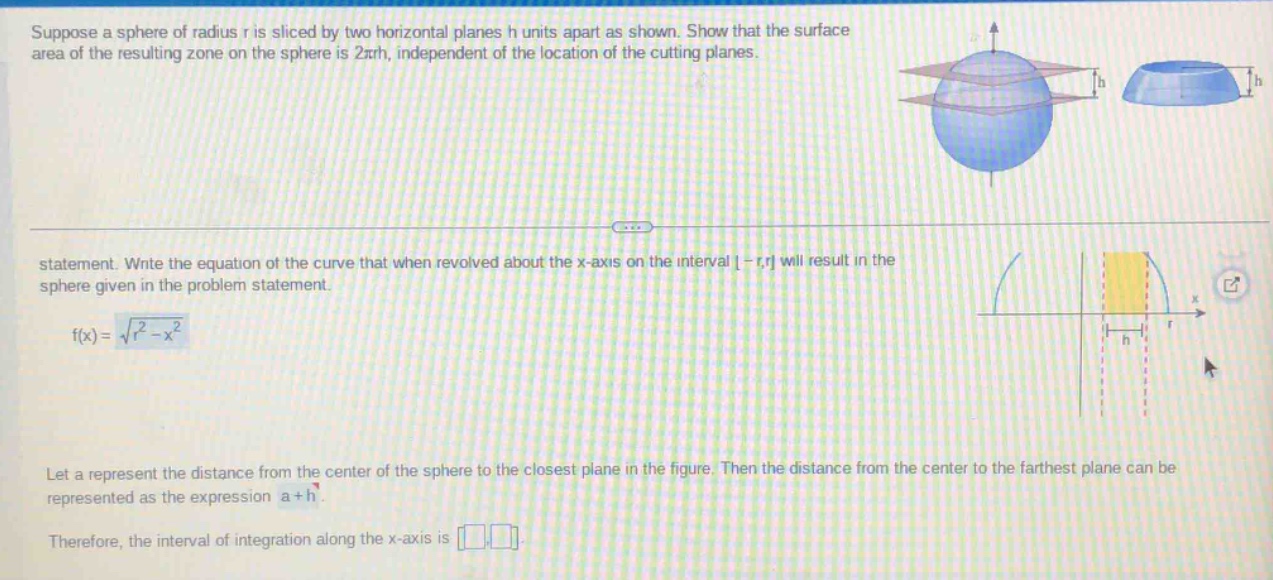
suppose a sphere of radius r is sliced by two horizontal planes h units apart as shown. show that the surface area of the resulting zone on the sphere is 2πrh, independent of the location of the cutting planes.\nstatement. write the equation of the curve that when revolved about the x - axis on the interval -r,r will result in the sphere given in the problem statement.\nf(x) = \\sqrt{r^{2}-x^{2}}\nlet a represent the distance from the center of the sphere to the closest plane in the figure. then the distance from the center to the farthest plane can be represented as the expression a + h.\ntherefore, the interval of integration along the x - axis is
Answer
Explanation:
Step1: Recall surface - area formula for revolution
The formula for the surface area (S) of a curve (y = f(x)) revolved about the (x -)axis on the interval ([a,b]) is (S=2\pi\int_{a}^{b}y\sqrt{1+(y')^{2}}dx). Given (y = f(x)=\sqrt{r^{2}-x^{2}}), first find the derivative (y'). Using the chain - rule, if (y=(r^{2}-x^{2})^{\frac{1}{2}}), then (y'=\frac{-x}{\sqrt{r^{2}-x^{2}}}).
Step2: Calculate (1+(y')^{2})
[ \begin{align*} 1+(y')^{2}&=1 +\frac{x^{2}}{r^{2}-x^{2}}\ &=\frac{r^{2}-x^{2}+x^{2}}{r^{2}-x^{2}}\ &=\frac{r^{2}}{r^{2}-x^{2}} \end{align*} ] So, (\sqrt{1+(y')^{2}}=\frac{r}{\sqrt{r^{2}-x^{2}}}).
Step3: Set up the integral for the surface area
The surface area (S = 2\pi\int_{a}^{a + h}\sqrt{r^{2}-x^{2}}\cdot\frac{r}{\sqrt{r^{2}-x^{2}}}dx). Since (y=\sqrt{r^{2}-x^{2}}) and (\sqrt{1+(y')^{2}}=\frac{r}{\sqrt{r^{2}-x^{2}}}), the integral becomes (S = 2\pi\int_{a}^{a + h}r\ dx).
Step4: Evaluate the integral
[ \begin{align*} S&=2\pi r\int_{a}^{a + h}dx\ &=2\pi r\left[x\right]_{a}^{a + h}\ &=2\pi r((a + h)-a)\ &=2\pi rh \end{align*} ]
Answer:
The surface area of the resulting zone on the sphere is (2\pi rh)