suppose f(x)=(x - 2)^3+3. use a graphing calculator (like desmos ) to graph the function f. a. determine the…
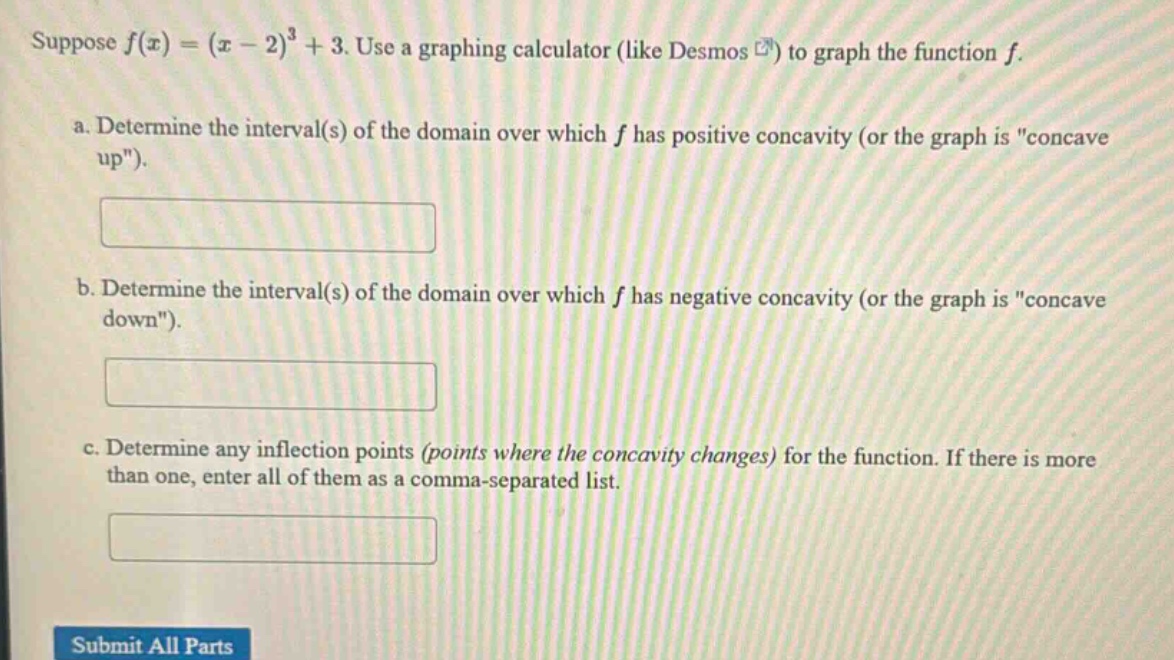
suppose f(x)=(x - 2)^3+3. use a graphing calculator (like desmos ) to graph the function f. a. determine the interval(s) of the domain over which f has positive concavity (or the graph is \concave up\). b. determine the interval(s) of the domain over which f has negative concavity (or the graph is \concave down\). c. determine any inflection points (points where the concavity changes) for the function. if there is more than one, enter all of them as a comma - separated list. submit all parts
Answer
Answer:
a. $(2,\infty)$ b. $(-\infty,2)$ c. $(2,3)$
Explanation:
Step1: Find the first - derivative
Given $f(x)=(x - 2)^3+3$. Using the chain - rule, if $u=x - 2$, then $y = u^3+3$. $\frac{dy}{du}=3u^2$ and $\frac{du}{dx}=1$. So $f^\prime(x)=3(x - 2)^2$.
Step2: Find the second - derivative
Differentiate $f^\prime(x)=3(x - 2)^2$ with respect to $x$. Using the chain - rule again, let $u=x - 2$, then $y = 3u^2$. $\frac{dy}{du}=6u$ and $\frac{du}{dx}=1$. So $f^{\prime\prime}(x)=6(x - 2)$.
Step3: Find where $f^{\prime\prime}(x)>0$ (concave up)
Set $f^{\prime\prime}(x)>0$. Then $6(x - 2)>0$. Solving for $x$ gives $x>2$. So the function is concave up on the interval $(2,\infty)$.
Step4: Find where $f^{\prime\prime}(x)<0$ (concave down)
Set $f^{\prime\prime}(x)<0$. Then $6(x - 2)<0$. Solving for $x$ gives $x<2$. So the function is concave down on the interval $(-\infty,2)$.
Step5: Find the inflection points
Set $f^{\prime\prime}(x)=0$. Then $6(x - 2)=0$, which gives $x = 2$. Substitute $x = 2$ into the original function $f(x)=(x - 2)^3+3$. $f(2)=(2 - 2)^3+3=3$. So the inflection point is $(2,3)$.