1. suppose that the waterwheel rotates at 6 revolutions per minute. you start a timer and find that 2…
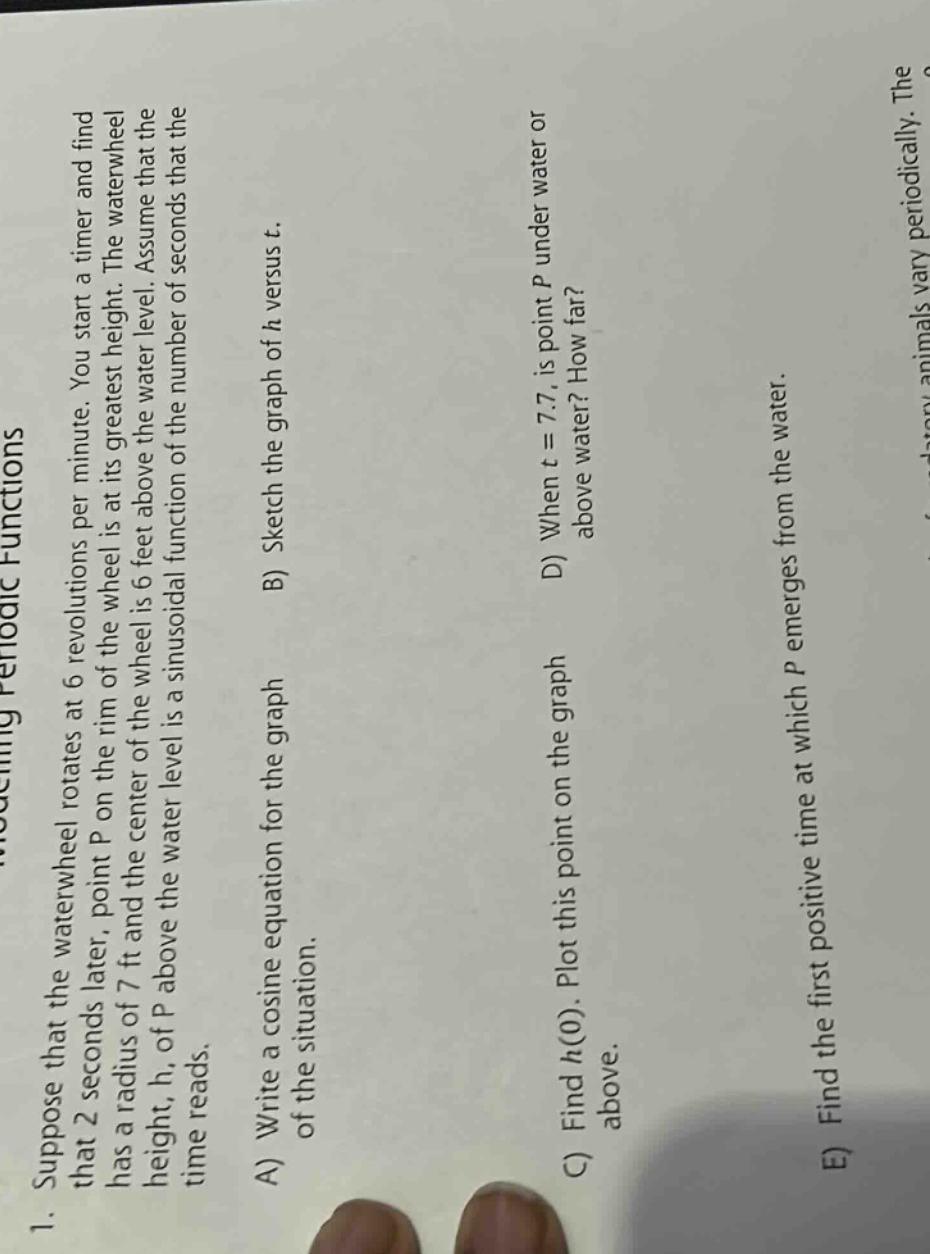
1. suppose that the waterwheel rotates at 6 revolutions per minute. you start a timer and find that 2 seconds later, point p on the rim of the waterwheel is at its greatest height. the waterwheel has a radius of 7 ft and the center of the wheel is 6 feet above the water level. assume that the water level is a sinusoidal function of the number of seconds that the time reads. a) write a cosine equation for the graph of h versus t. b) sketch the graph of the situation. c) find h(0). plot this point on the graph above. d) when t = 7.7, is point p under water or above water? how far? e) find the first positive time at which p emerges from the water.
Answer
Explanation:
Step1: Find the angular - frequency
The water - wheel rotates at 6 revolutions per minute. One revolution is $2\pi$ radians and 1 minute = 60 seconds. So the angular - frequency $\omega=\frac{6\times2\pi}{60}=\frac{\pi}{5}$ radians per second.
Step2: Write the general form of the cosine function
The general form of a cosine function for a periodic motion is $h(t)=A\cos(\omega t+\varphi)+k$. The radius of the wheel is $r = 7$ feet and the center of the wheel is 6 feet above the water level. The amplitude $A = 7$, the vertical shift $k=6$, and assume $\varphi = 0$ (since no phase - shift information is given). So the cosine equation is $h(t)=7\cos(\frac{\pi}{5}t)+6$.
Step3: Find $h(0)$
Substitute $t = 0$ into the equation $h(t)=7\cos(\frac{\pi}{5}t)+6$. Since $\cos(0)=1$, then $h(0)=7\times1 + 6=13$ feet.
Step4: Analyze the position of the point at $t = 7.7$ seconds
Substitute $t = 7.7$ into $h(t)=7\cos(\frac{\pi}{5}t)+6$. First, calculate $\frac{\pi}{5}\times7.7=\frac{7.7\pi}{5}\approx4.84$. Then $\cos(4.84)\approx - 0.97$. So $h(7.7)=7\times(-0.97)+6=-6.79 + 6=-0.79$ feet. The point is $0.79$ feet below the water level.
Step5: Find the first positive time when the point emerges from the water
The point is in the water when $h(t)<6$. We want to find $t>0$ such that $h(t)=6$, i.e., $7\cos(\frac{\pi}{5}t)+6 = 6$. Then $\cos(\frac{\pi}{5}t)=0$. The general solution for $\cos(x)=0$ is $x=(2n + 1)\frac{\pi}{2}$, $n\in\mathbb{Z}$. So $\frac{\pi}{5}t=(2n + 1)\frac{\pi}{2}$. Solving for $t$, we get $t=\frac{5(2n + 1)}{2}$. For the first positive $t$, when $n = 0$, $t = 2.5$ seconds.
Answer:
A) $h(t)=7\cos(\frac{\pi}{5}t)+6$ B) (Sketching the graph: The amplitude is 7, the vertical shift is 6, and the period $T=\frac{2\pi}{\omega}=\frac{2\pi}{\frac{\pi}{5}} = 10$ seconds. The graph oscillates between $y = 6 + 7=13$ and $y = 6-7=-1$ with a period of 10 seconds) C) $h(0)=13$ feet D) 0.79 feet below the water level E) 2.5 seconds