5. suppose we have a function f(x) with the following properties: • f(x)=0 only when x = -1 and x = 3 •…
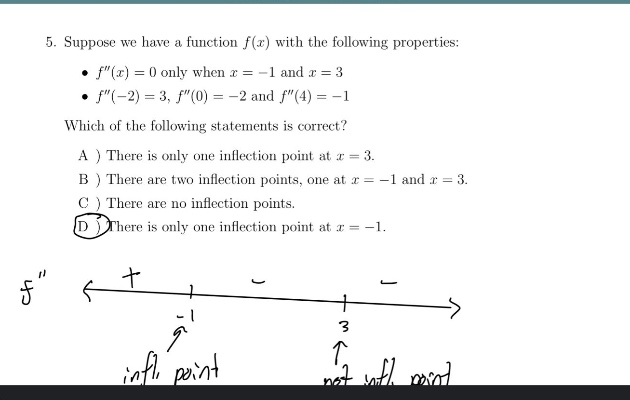
5. suppose we have a function f(x) with the following properties: • f(x)=0 only when x = -1 and x = 3 • f(-2)=3, f(0)= -2 and f(4)= -1 which of the following statements is correct? a ) there is only one inflection point at x = 3. b ) there are two inflection points, one at x = -1 and x = 3. c ) there are no inflection points. d ) there is only one inflection point at x = -1.
Answer
Explanation:
Step1: Recall inflection - point definition
An inflection point of a function $y = f(x)$ occurs where the second - derivative $f''(x)$ changes sign.
Step2: Analyze the sign of $f''(x)$ at given points
We know that $f''(x)=0$ only when $x = - 1$ and $x = 3$. Also, $f''(-2)=3>0$, $f''(0)= - 2<0$, and $f''(4)= - 1<0$. Since $f''(x)$ changes sign from positive (when $x=-2$) to negative (when $x = 0$) at $x=-1$ (because $f''(x)$ is continuous between $x=-2$ and $x = 0$ as it is differentiable), $x=-1$ is an inflection point. For $x = 3$, since $f''(0)=-2<0$ and $f''(4)=-1<0$, $f''(x)$ does not change sign at $x = 3$.
Answer:
D. There is only one inflection point at $x=-1$.