6. suppose f(x)=xe^(-x). which of the following is true? a ) f(x) has a local maximum at x = -0.5 b ) f(x)…
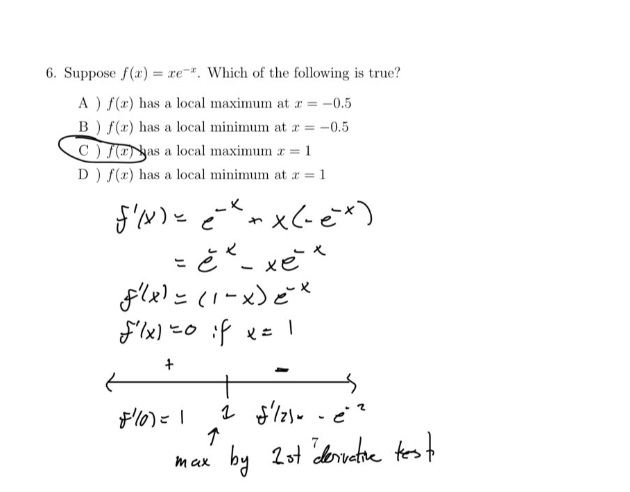
6. suppose f(x)=xe^(-x). which of the following is true? a ) f(x) has a local maximum at x = -0.5 b ) f(x) has a local minimum at x = -0.5 c ) f(x) has a local maximum x = 1 d ) f(x) has a local minimum at x = 1 f(x)=e^(-x)+x(-e^(-x)) =e^(-x)-xe^(-x) f(x)=(1 - x)e^(-x) f(x)=0 if x = 1 + - f(0)=1 f(2)=-e^(-2) max by 2nd derivative test
Answer
Explanation:
Step1: Find the first - derivative
We use the product rule $(uv)^\prime = u^\prime v+uv^\prime$, where $u = x$ and $v = e^{-x}$. So $f^\prime(x)=e^{-x}+x(-e^{-x})=e^{-x}-xe^{-x}=(1 - x)e^{-x}$.
Step2: Find the critical points
Set $f^\prime(x)=0$. Since $e^{-x}\neq0$ for all real $x$, we solve $1 - x = 0$, getting $x = 1$.
Step3: Use the first - derivative test
Choose a test point to the left of $x = 1$, say $x = 0$. Then $f^\prime(0)=(1 - 0)e^{-0}=1>0$. Choose a test point to the right of $x = 1$, say $x = 2$. Then $f^\prime(2)=(1 - 2)e^{-2}=-e^{-2}<0$. Since $f^\prime(x)$ changes sign from positive to negative at $x = 1$, $f(x)$ has a local maximum at $x = 1$.
Answer:
C. $f(x)$ has a local maximum at $x = 1$