if the table of the function contains exactly two potential turning points, one with an input value of -1…
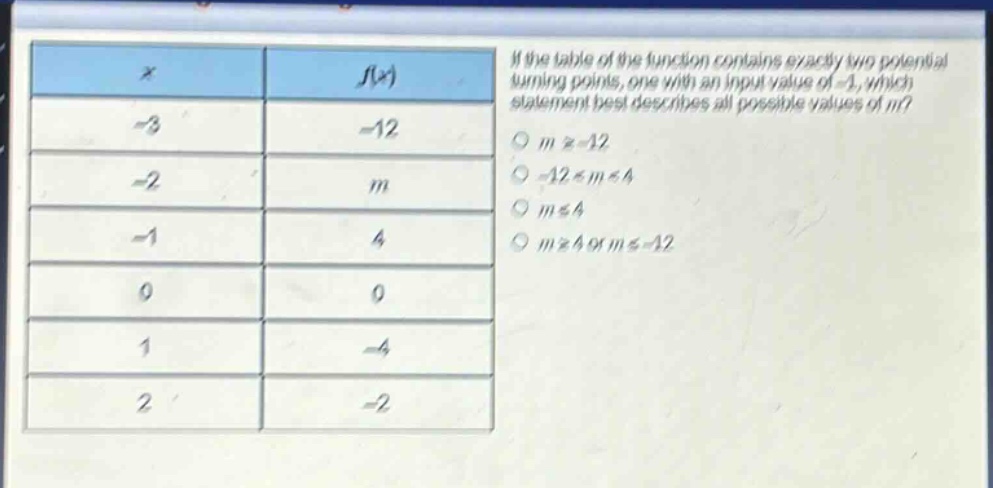
if the table of the function contains exactly two potential turning points, one with an input value of -1, which statement best describes all possible values of m?\n-3 -12\n-2 m\n-1 4\n0 0\n1 -4\n2 -2\nm ≥ -12\n-12 < m < 4\nm ≤ 4\nm ≥ 4 or m ≤ -12
Answer
Explanation:
Step1: Understand turning - point concept
A turning point of a function is a point where the function changes from increasing to decreasing or vice - versa.
Step2: Analyze the given data
We know one turning point is at (x = - 1) with (f(-1)=4). We have (f(-3)=-12), (f(-2)=m), (f(0) = 0), (f(1)=-4), (f(2)=-2).
Step3: Consider the behavior around the known turning - point
For there to be exactly two turning points, the function value at (x=-2) (i.e., (m)) must be such that the function changes its increasing/decreasing behavior appropriately. Since (f(-3)=-12) and (f(-1) = 4), for there to be two turning points, (m) must satisfy (-12<m<4). If (m\geq4) or (m\leq - 12), the number of turning points will not be exactly two.
Answer:
(-12 < m<4)