the table gives all of the relative extrema of the polar function r = f(θ) for all input values of θ in the…
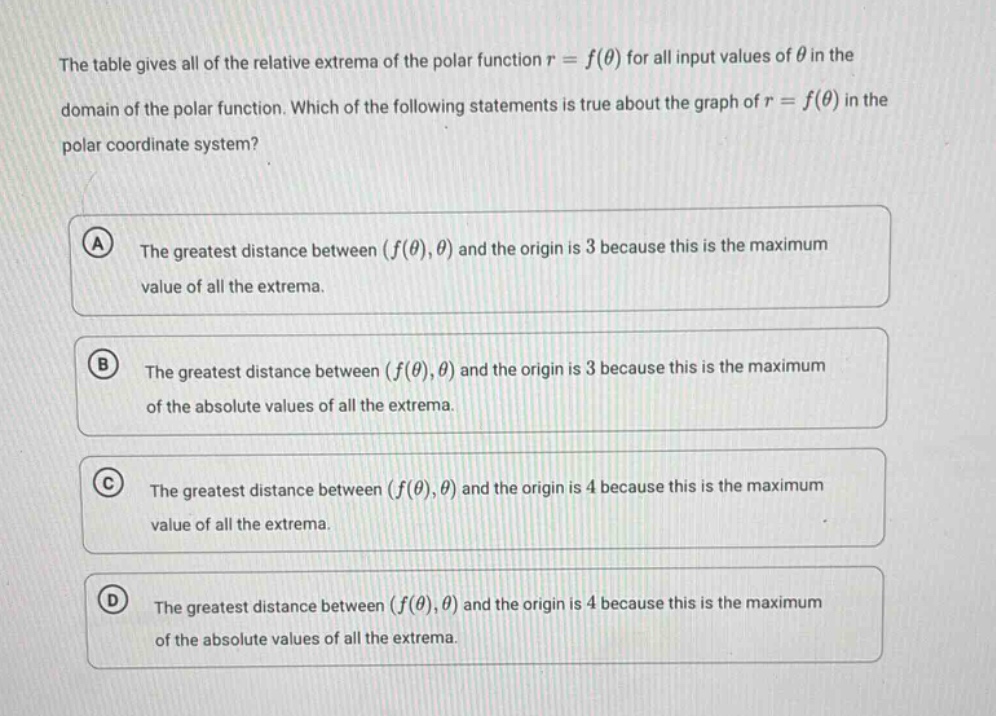
the table gives all of the relative extrema of the polar function r = f(θ) for all input values of θ in the domain of the polar function. which of the following statements is true about the graph of r = f(θ) in the polar coordinate system? a the greatest distance between (f(θ),θ) and the origin is 3 because this is the maximum value of all the extrema. b the greatest distance between (f(θ),θ) and the origin is 3 because this is the maximum of the absolute values of all the extrema. c the greatest distance between (f(θ),θ) and the origin is 4 because this is the maximum value of all the extrema. d the greatest distance between (f(θ),θ) and the origin is 4 because this is the maximum of the absolute values of all the extrema.
Answer
Explanation:
Step1: Recall polar - coordinate concept
In polar coordinates, the distance between the point $(r,\theta)$ and the origin is given by $|r|$.
Step2: Analyze the key - factor for greatest distance
To find the greatest distance between the point $(f(\theta),\theta)$ and the origin, we need to find the maximum of the absolute values of all the relative extrema of $r = f(\theta)$.
Answer:
We don't know the actual values of the extrema from the problem - statement text, but based on the concept of distance in polar coordinates, the correct statement is the one that says the greatest distance between $(f(\theta),\theta)$ and the origin is the maximum of the absolute values of all the extrema. Without seeing the actual values of the extrema in the table, if we assume that the maximum of the absolute values of the extrema is 4 (since options C and D mention 4 as the maximum value of the relevant quantity), the correct answer is D. Option D. The greatest distance between $(f(\theta),\theta)$ and the origin is 4 because this is the maximum of the absolute values of all the extrema.