the table gives selected values of the differentiable function g. x -20 -18 -16 -14 g(x) 10 -20 30 -40 can…
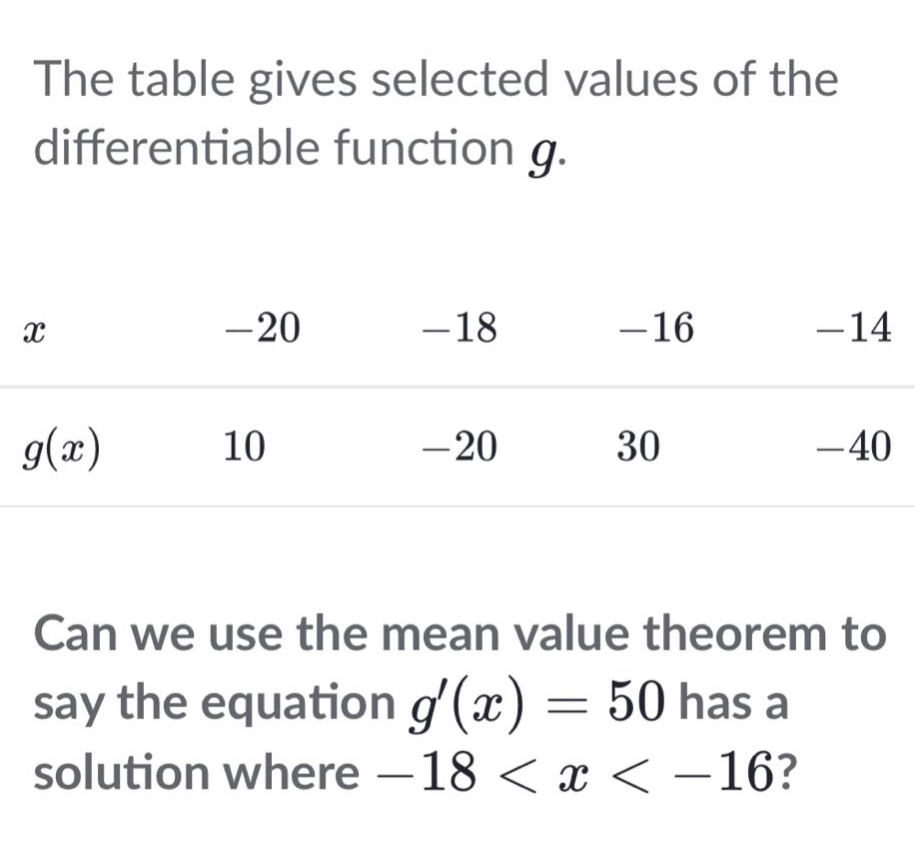
the table gives selected values of the differentiable function g. x -20 -18 -16 -14 g(x) 10 -20 30 -40 can we use the mean value theorem to say the equation g(x)=50 has a solution where -18<x<-16?
Answer
Explanation:
Step1: Recall mean - value theorem conditions
The mean - value theorem states that if a function $y = g(x)$ is continuous on the closed interval $[a,b]$ and differentiable on the open interval $(a,b)$, then there exists at least one $c\in(a,b)$ such that $g^{\prime}(c)=\frac{g(b)-g(a)}{b - a}$.
Step2: Check the conditions for $g(x)$ on $[-18,-16]$
We are given that $g(x)$ is a differentiable function. Since differentiability implies continuity, $g(x)$ is continuous on $[-18,-16]$ and differentiable on $(-18,-16)$.
Step3: Calculate the average rate of change
Let $a=-18$ and $b = - 16$. Then $g(a)=-20$ and $g(b)=30$. The average rate of change $\frac{g(b)-g(a)}{b - a}=\frac{30-(-20)}{-16-(-18)}=\frac{30 + 20}{-16 + 18}=\frac{50}{2}=25$.
Step4: Compare with the given derivative value
We want to know if $g^{\prime}(x)=50$ has a solution in $(-18,-16)$. The mean - value theorem only guarantees that there is a $c\in(-18,-16)$ such that $g^{\prime}(c)=\frac{g(-16)-g(-18)}{-16-(-18)} = 25$, not $50$.
Answer:
No