the table gives values of a polar function r = f(θ) for selected values of θ. if the value of r = f(π/12) is…
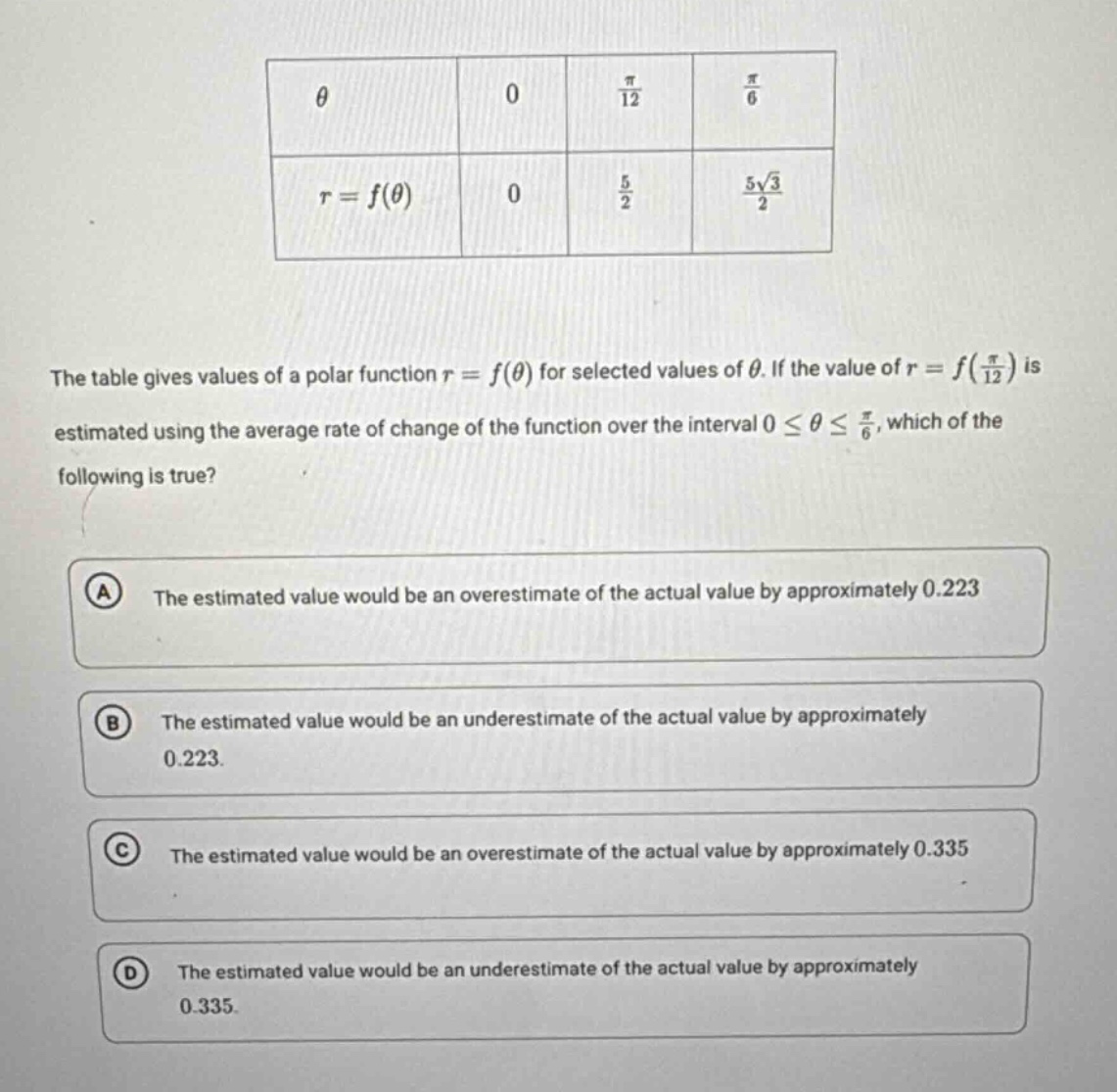
the table gives values of a polar function r = f(θ) for selected values of θ. if the value of r = f(π/12) is estimated using the average rate of change of the function over the interval 0 ≤ θ ≤ π/6, which of the following is true? a the estimated value would be an overestimate of the actual value by approximately 0.223 b the estimated value would be an underestimate of the actual value by approximately 0.223. c the estimated value would be an overestimate of the actual value by approximately 0.335 d the estimated value would be an underestimate of the actual value by approximately 0.335.
Answer
Explanation:
Step1: Calculate average rate of change
The average - rate of change of a function $y = f(x)$ over the interval $[a,b]$ is $\frac{f(b)-f(a)}{b - a}$. Here, $a = 0$, $b=\frac{\pi}{6}$, $f(0)=0$, and $f(\frac{\pi}{6})=\frac{5\sqrt{3}}{2}$. The average rate of change of $r = f(\theta)$ over the interval $[0,\frac{\pi}{6}]$ is $\frac{f(\frac{\pi}{6})-f(0)}{\frac{\pi}{6}-0}=\frac{\frac{5\sqrt{3}}{2}-0}{\frac{\pi}{6}}=\frac{15\sqrt{3}}{\pi}$.
Step2: Estimate $f(\frac{\pi}{12})$
Using the point - slope form of a linear approximation (since we are using the average rate of change as the slope), with the point $(\theta_1,r_1)=(0,0)$ and slope $m = \frac{15\sqrt{3}}{\pi}$, the linear approximation formula is $r - r_1=m(\theta-\theta_1)$. Substituting $\theta=\frac{\pi}{12}$, we get $r=\frac{15\sqrt{3}}{\pi}\times\frac{\pi}{12}=\frac{5\sqrt{3}}{4}\approx2.165$. The actual value of $f(\frac{\pi}{12})=\frac{5}{2} = 2.5$.
Step3: Find the difference
The difference between the actual value and the estimated value is $2.5 - 2.165=0.335$. Since the actual value is larger, the estimated value is an underestimate.
Answer:
D. The estimated value would be an underestimate of the actual value by approximately 0.335.