which table shows a function that is increasing only over the interval $(-2,1)$, and nowhere else?
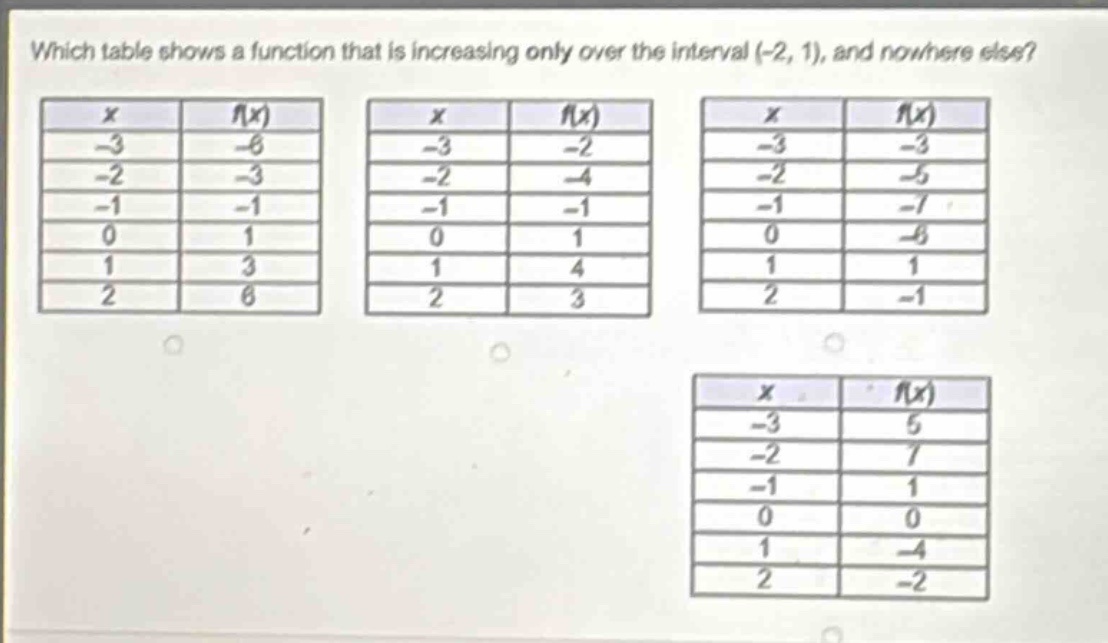
which table shows a function that is increasing only over the interval $(-2,1)$, and nowhere else?
Answer
Explanation:
Step1: Analyze the first table
For (x) from (-3) to (-2): (f(x)) goes from (-6) to (-3) (increasing). For (x) from (-2) to (2): (f(x)) keeps increasing ((-3\to - 1\to1\to3\to6)). So it's increasing not only on ((-2,1)).
Step2: Analyze the second table
For (x=-3) to (x = - 2): (f(x)) goes from (-2) to (-4) (decreasing). For (x=-2) to (x=-1): (f(x)) goes from (-4) to (-1) (increasing). For (x=-1) to (x = 1): (f(x)) goes from (-1) to (4) (increasing). For (x = 1) to (x=2): (f(x)) goes from (4) to (3) (decreasing). But it's increasing on ((-2,1)) and ((-1,1)) (a part of ((-2,1)) is also in another increasing interval).
Step3: Analyze the third table
For (x=-3) to (x=-2): (f(x)) goes from (-3) to (-5) (decreasing). For (x=-2) to (x=-1): (f(x)) goes from (-5) to (-7) (decreasing). For (x=-1) to (x = 0): (f(x)) goes from (-7) to (-6) (increasing). For (x=0) to (x = 1): (f(x)) goes from (-6) to (1) (increasing). For (x = 1) to (x=2): (f(x)) goes from (1) to (-1) (decreasing). It's increasing only on ((-1,1)) (a sub - interval of ((-2,1)) is increasing, but not the whole ((-2,1))).
Step4: Analyze the fourth table
For (x=-3) to (x=-2): (f(x)) goes from (5) to (7) (increasing). For (x=-2) to (x=-1): (f(x)) goes from (7) to (1) (decreasing). For (x=-1) to (x = 0): (f(x)) goes from (1) to (0) (decreasing). For (x=0) to (x = 1): (f(x)) goes from (0) to (-4) (decreasing). For (x = 1) to (x=2): (f(x)) goes from (-4) to (-2) (increasing). This is not the case.
Answer:
The second table (the table with (x=-3,f(x)=-2); (x = - 2,f(x)=-4); (x=-1,f(x)=-1); (x = 0,f(x)=1); (x = 1,f(x)=4); (x=2,f(x)=3))