the table shows three unique functions. which statements can be used to compare the functions? select two…
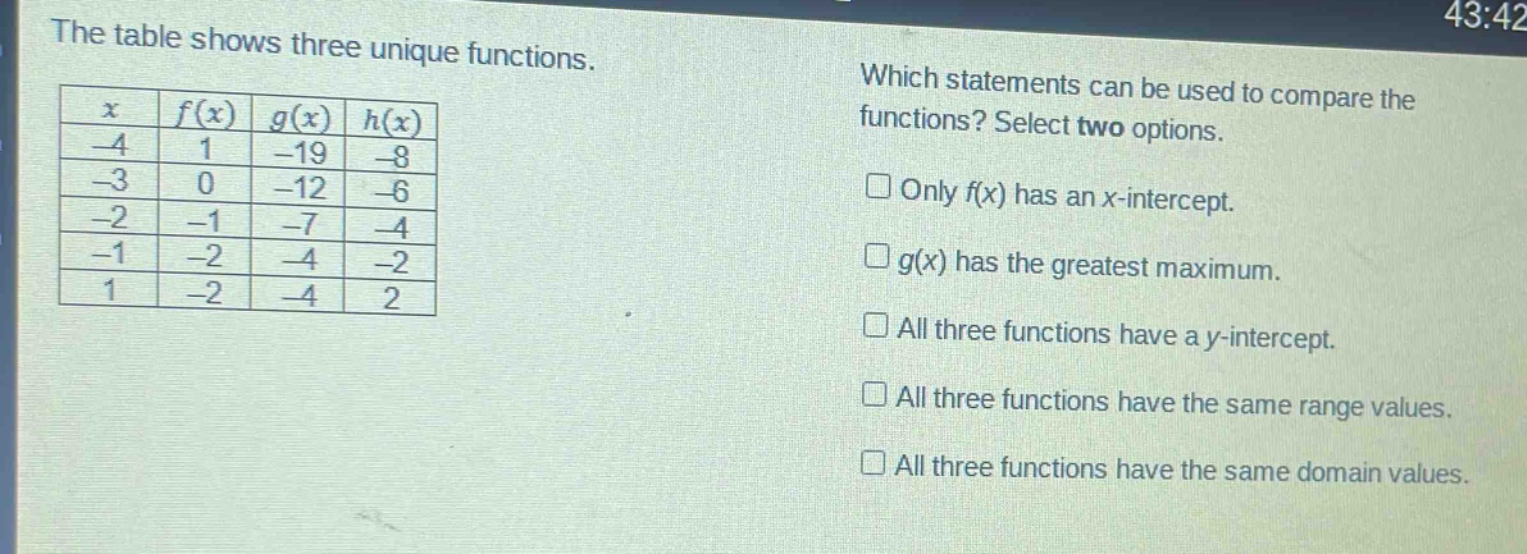
the table shows three unique functions. which statements can be used to compare the functions? select two options. only f(x) has an x - intercept. g(x) has the greatest maximum. all three functions have a y - intercept. all three functions have the same range values. all three functions have the same domain values.
Answer
Explanation:
Step 1: Check x-intercepts
An x-intercept occurs where ( f(x) = 0 ). For ( f(x) ), ( f(-3) = 0 ). Neither ( g(x) ) nor ( h(x) ) have 0 in their values for the given ( x ), so "Only ( f(x) ) has an x-intercept" is correct.
Step 2: Compare maximum values
Maximum values: ( f(x) ) max is 1, ( g(x) ) max is -4, ( h(x) ) max is 2. ( h(x) ) has the greatest maximum, so " ( g(x) ) has the greatest maximum" is incorrect.
Step 3: Check y-intercepts
A y-intercept requires ( x = 0 ), but ( x = 0 ) is not in the domain, so we cannot confirm y-intercepts exist. "All three functions have a y-intercept" is incorrect.
Step 4: Compare ranges
Ranges: ( f(x): {1, 0, -1, -2} ), ( g(x): {-19, -12, -7, -4} ), ( h(x): {-8, -6, -4, -2, 2} ). Ranges differ, so "All three functions have the same range values" is incorrect.
Step 5: Check domains
Domains for all functions are ( {-4, -3, -2, -1, 1} ), so "All three functions have the same domain values" is correct.
Answer:
Only ( f(x) ) has an x-intercept., All three functions have the same domain values.