3. the table shows the values of a function g(x) for different values of x. which statement is true? a. the…
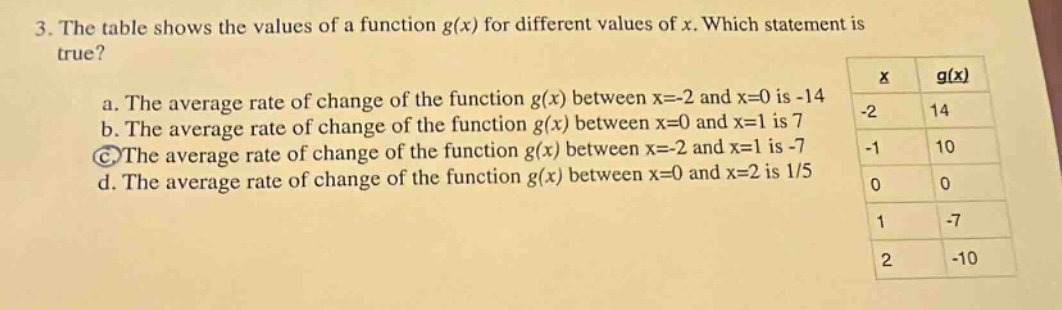
3. the table shows the values of a function g(x) for different values of x. which statement is true? a. the average rate of change of the function g(x) between x=-2 and x=0 is -14 b. the average rate of change of the function g(x) between x=0 and x=1 is 7 c. the average rate of change of the function g(x) between x=-2 and x=1 is -7 d. the average rate of change of the function g(x) between x=0 and x=2 is 1/5 x g(x) -2 14 -1 10 0 0 1 -7 2 -10
Answer
Explanation:
Step1: Recall average - rate - of - change formula
The average rate of change of a function $y = g(x)$ over the interval $[a,b]$ is $\frac{g(b)-g(a)}{b - a}$.
Step2: Check option a
For the interval $[-2,0]$, $a=-2$, $b = 0$, $g(-2)=14$, $g(0)=0$. Then $\frac{g(0)-g(-2)}{0-(-2)}=\frac{0 - 14}{2}=-7\neq - 14$.
Step3: Check option b
For the interval $[0,1]$, $a = 0$, $b=1$, $g(0)=0$, $g(1)=-7$. Then $\frac{g(1)-g(0)}{1 - 0}=\frac{-7-0}{1}=-7\neq7$.
Step4: Check option c
For the interval $[-2,1]$, $a=-2$, $b = 1$, $g(-2)=14$, $g(1)=-7$. Then $\frac{g(1)-g(-2)}{1-(-2)}=\frac{-7 - 14}{3}=\frac{-21}{3}=-7$.
Step5: Check option d
For the interval $[0,2]$, $a = 0$, $b=2$, $g(0)=0$, $g(2)=-10$. Then $\frac{g(2)-g(0)}{2 - 0}=\frac{-10-0}{2}=-5\neq\frac{1}{5}$.
Answer:
c. The average rate of change of the function $g(x)$ between $x = - 2$ and $x = 1$ is $-7$