the table of values for the functions $f(x)=3^{x}$ and $g(x)=sqrt{-5x + 5}$ from $x = 0$ to $x = 1$ is…
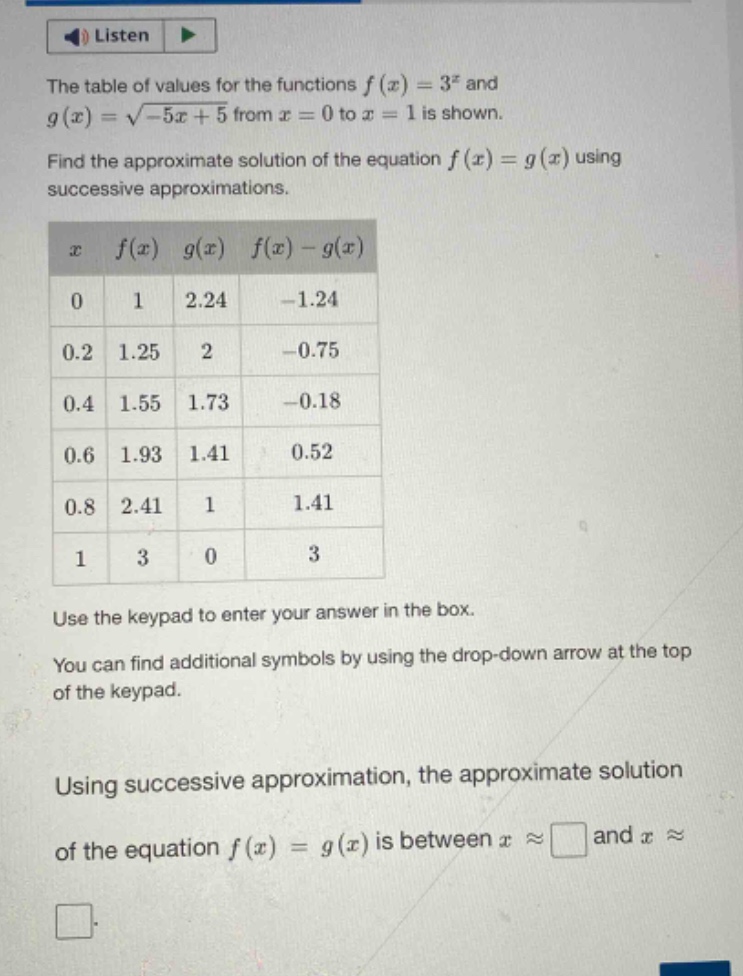
the table of values for the functions $f(x)=3^{x}$ and $g(x)=sqrt{-5x + 5}$ from $x = 0$ to $x = 1$ is shown. find the approximate solution of the equation $f(x)=g(x)$ using successive approximations.\n|$x$|$f(x)$|$g(x)$|$f(x)-g(x)$|\n|----|----|----|----|\n|0|1|2.24|-1.24|\n|0.2|1.25|2|-0.75|\n|0.4|1.55|1.73|-0.18|\n|0.6|1.93|1.41|0.52|\n|0.8|2.41|1|1.41|\n|1|3|0|3|\nuse the keypad to enter your answer in the box.\nyou can find additional symbols by using the drop - down arrow at the top of the keypad.\nusing successive approximation, the approximate solution of the equation $f(x)=g(x)$ is between $xapproxsquare$ and $xapproxsquare$.
Answer
Explanation:
Step1: Analyze the sign - change
We are looking for when (f(x)-g(x)) changes sign. When (x = 0.4), (f(0.4)-g(0.4)=- 0.18) (negative). When (x = 0.6), (f(0.6)-g(0.6)=0.52) (positive).
Step2: Determine the interval
Since the function (y = f(x)-g(x)) is continuous (as (f(x)=3^{x}) and (g(x)=\sqrt{-5x + 5}) are continuous on the interval ([0,1])), by the Intermediate - Value Theorem, the root of the equation (f(x)=g(x)) (i.e., (f(x)-g(x)=0)) lies in the interval where the sign of (f(x)-g(x)) changes.
Answer:
(0.4); (0.6)