y = tan(6x - π/6)\nπ/6\ngraph the function.
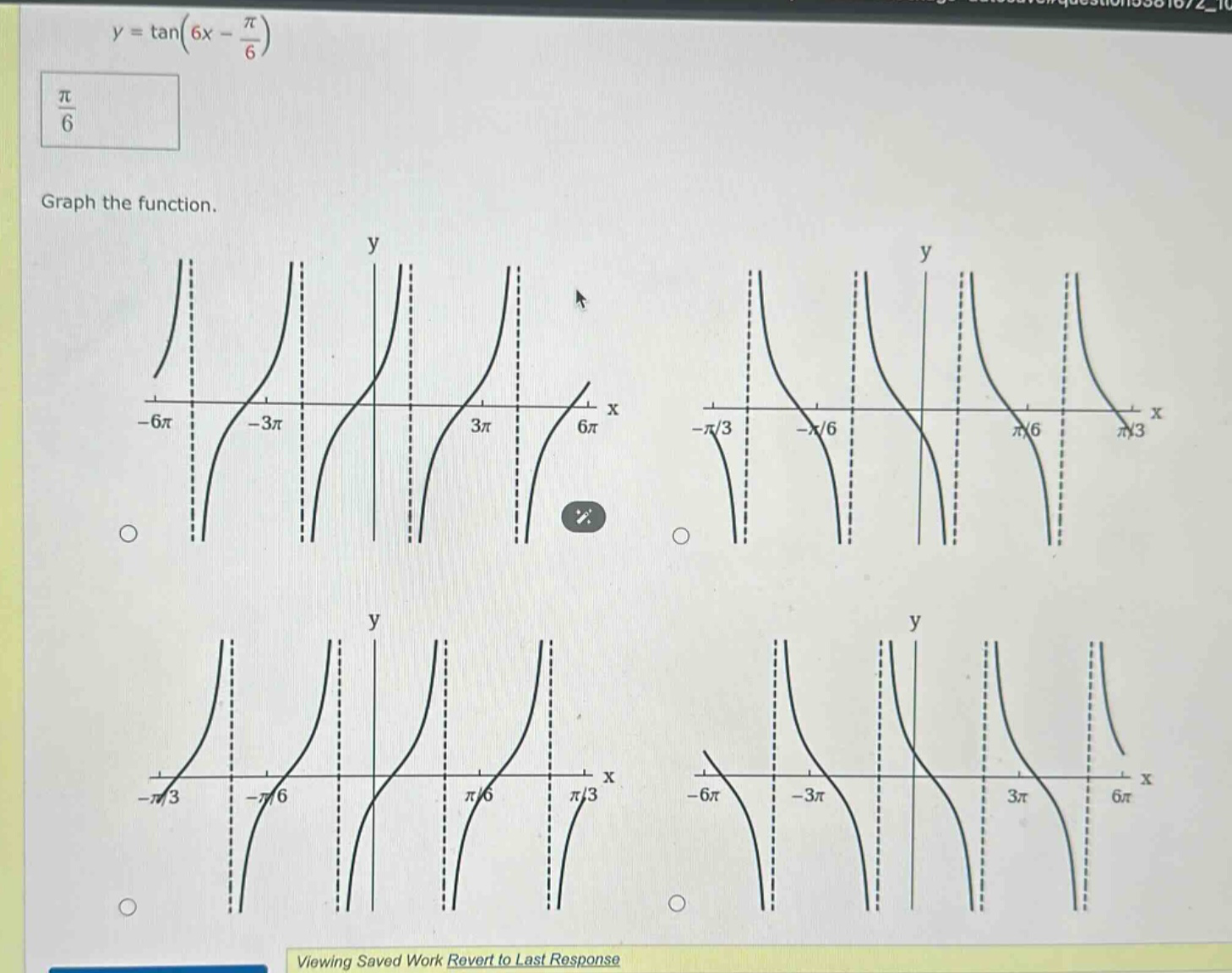
y = tan(6x - π/6)\nπ/6\ngraph the function.
Answer
Explanation:
Step1: Recall period formula for tangent
The period of $y = A\tan(Bx - C)$ is $\frac{\pi}{|B|}$. For $y=\tan(6x-\frac{\pi}{6})$, $B = 6$, so the period is $\frac{\pi}{6}$.
Step2: Find vertical - asymptotes
Set $6x-\frac{\pi}{6}=k\pi+\frac{\pi}{2}$, where $k\in\mathbb{Z}$. Solve for $x$: [ \begin{align*} 6x-\frac{\pi}{6}&=k\pi+\frac{\pi}{2}\ 6x&=k\pi+\frac{\pi}{2}+\frac{\pi}{6}\ 6x&=k\pi+\frac{3\pi + \pi}{6}\ 6x&=k\pi+\frac{4\pi}{6}\ x&=\frac{k\pi}{6}+\frac{\pi}{9} \end{align*} ] When $k = 0$, $x=\frac{\pi}{9}$; when $k=- 1$, $x=-\frac{\pi}{6}+\frac{\pi}{9}=-\frac{\pi}{18}$. The tangent function $y = \tan(6x-\frac{\pi}{6})$ has a shape similar to the basic tangent function $y=\tan(x)$ but is compressed horizontally due to the coefficient of $x$. The correct graph will have a period of $\frac{\pi}{6}$ and vertical asymptotes at $x=\frac{k\pi}{6}+\frac{\pi}{9},k\in\mathbb{Z}$. Looking at the options, we can identify the graph by its period and the position of asymptotes. The graph with a period of $\frac{\pi}{6}$ (distance between consecutive vertical asymptotes) is the correct one.
Answer:
The graph with a period of $\frac{\pi}{6}$ and appropriate vertical - asymptotes (the one where the distance between consecutive vertical dashed lines is $\frac{\pi}{6}$) should be chosen. Without specific labels on the options to point out exactly which one, the key is to look for the graph with the correct period and asymptote positions as calculated above.