if $y = \\tan u$, $u = v-\frac{1}{v}$, and $v = \\ln x$, what is the value of $\frac{dy}{dx}$ at $x = e$?\na…
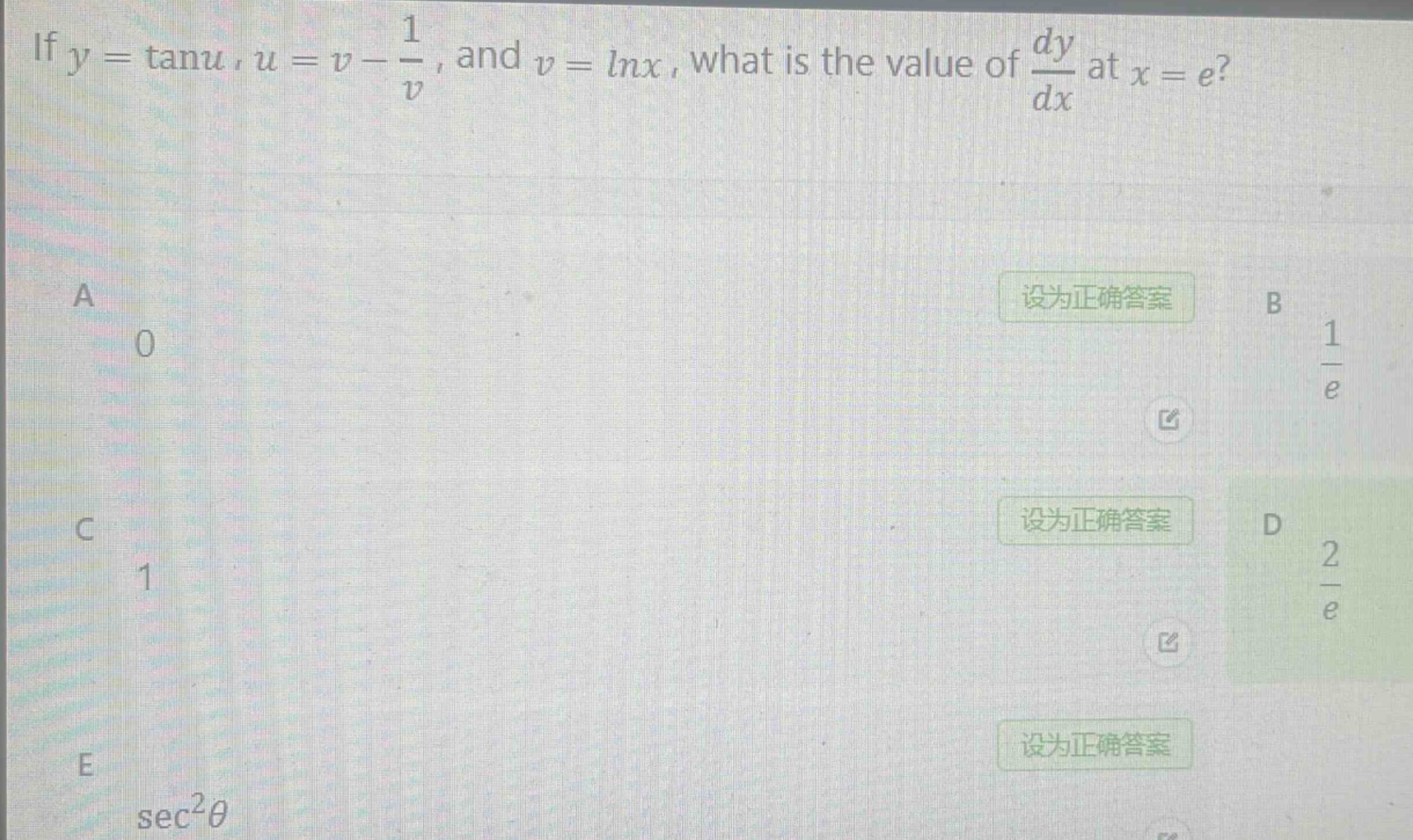
if $y = \\tan u$, $u = v-\frac{1}{v}$, and $v = \\ln x$, what is the value of $\frac{dy}{dx}$ at $x = e$?\na 0\nb $\frac{1}{e}$\nc 1\nd $\frac{2}{e}$\ne $\\sec^{2}\\theta$
Answer
Explanation:
Step1: Find $\frac{dy}{du}$
By the derivative formula of tangent function, $\frac{dy}{du}=\sec^{2}u$.
Step2: Find $\frac{du}{dv}$
Differentiate $u = v-\frac{1}{v}=v - v^{-1}$ with respect to $v$. Using the power - rule $\frac{d}{dv}(v^n)=nv^{n - 1}$, we get $\frac{du}{dv}=1 + v^{-2}=1+\frac{1}{v^{2}}$.
Step3: Find $\frac{dv}{dx}$
Since $v=\ln x$, by the derivative formula of natural logarithm function, $\frac{dv}{dx}=\frac{1}{x}$.
Step4: Use the chain - rule $\frac{dy}{dx}=\frac{dy}{du}\cdot\frac{du}{dv}\cdot\frac{dv}{dx}$
Substitute the above results: $\frac{dy}{dx}=\sec^{2}u\cdot(1 + \frac{1}{v^{2}})\cdot\frac{1}{x}$.
Step5: When $x = e$
First, when $x = e$, $v=\ln x=\ln e = 1$. Then, $u=v-\frac{1}{v}=1 - 1=0$. Substitute $u = 0$, $v = 1$ and $x = e$ into $\frac{dy}{dx}$: $\frac{dy}{dx}=\sec^{2}(0)\cdot(1+\frac{1}{1^{2}})\cdot\frac{1}{e}$. Since $\sec(0)=\frac{1}{\cos(0)} = 1$, then $\sec^{2}(0)=1$. So $\frac{dy}{dx}=1\times(1 + 1)\times\frac{1}{e}=\frac{2}{e}$.
Answer:
D. $\frac{2}{e}$