f(x)=2 tan x. (a) solve f(x)= - 2. (b) for what values of x is f(x)> - 2 on the interval (-π/2,π/2)? (a)…
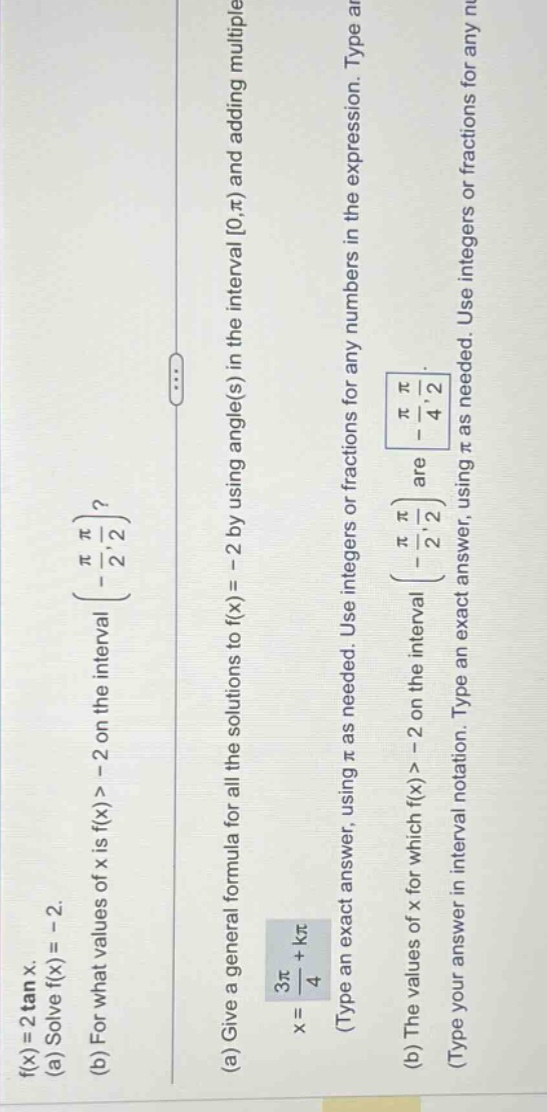
f(x)=2 tan x. (a) solve f(x)= - 2. (b) for what values of x is f(x)> - 2 on the interval (-π/2,π/2)? (a) give a general formula for all the solutions to f(x)= - 2 by using angle(s) in the interval 0,π) and adding multiples of π. x = 3π/4 + kπ (type an exact answer, using π as needed. use integers or fractions for any numbers in the expression. type your answer in interval notation. (b) the values of x for which f(x)> - 2 on the interval (-π/2,π/2) are (-π/4,π/2) (type an exact answer, using π as needed. use integers or fractions for any numbers in the expression.)
Answer
Explanation:
Step1: Recall tangent - equation solving
We know that if (y = \tan x), and (\tan x=a), then (x = \arctan(a)+k\pi), (k\in\mathbb{Z}). Given (f(x)=2\tan x - 2), when (f(x)> - 2), we first set up the inequality. [ \begin{align*} 2\tan x-2&>-2\ 2\tan x&>0\ \tan x&>0 \end{align*} ] The general solution of the equation (\tan x = 0) is (x = k\pi), (k\in\mathbb{Z}). The tangent function (y = \tan x) has a period of (\pi) and is positive in the intervals ((k\pi,k\pi+\frac{\pi}{2})), (k\in\mathbb{Z}).
Step2: Find solutions in the given interval
(a) The general formula for all solutions of (2\tan x-2 > - 2) (i.e., (\tan x>0)) is (x=k\pi+\frac{\pi}{4}), (k\in\mathbb{Z}). (b) For the interval ((-\frac{\pi}{2},\frac{\pi}{2})), when (k = 0), the values of (x) for which (f(x)>-2) are (x\in(0,\frac{\pi}{2})).
Answer:
(a) (x = k\pi+\frac{\pi}{4},k\in\mathbb{Z}) (b) ((0,\frac{\pi}{2}))