(tangent function behavior lc) the function f(x) = tan x changes from a decreasing rate of change to an…
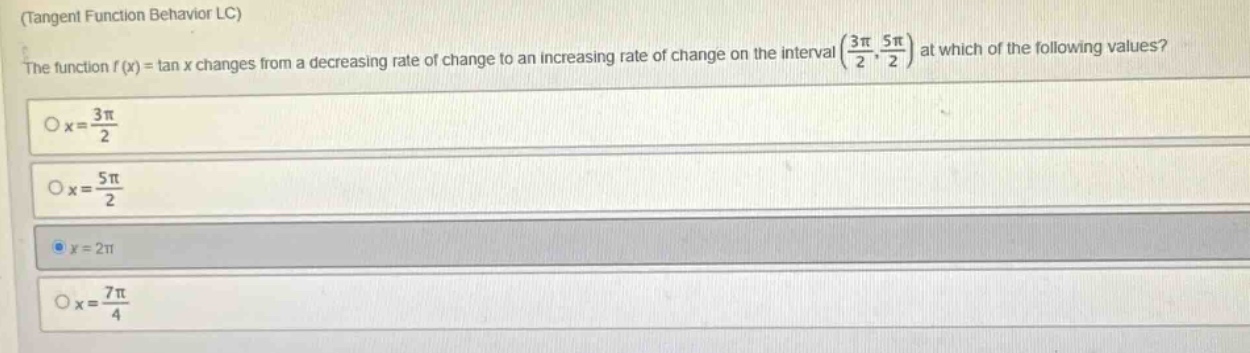
(tangent function behavior lc) the function f(x) = tan x changes from a decreasing rate of change to an increasing rate of change on the interval (3π/2, 5π/2) at which of the following values? o x = 3π/2 o x = 5π/2 x = 2π o x = 7π/4
Answer
Answer:
C. $x = 2\pi$
Explanation:
Step1: Recall tangent - function properties
The derivative of $y = \tan x$ is $y'=\sec^{2}x$. The second - derivative $y'' = 2\sec^{2}x\tan x$. The rate of change of the function $y = \tan x$ is given by its first - derivative, and the change in the rate of change is given by the second - derivative. We want to find where the second - derivative changes sign from negative to positive on the interval $\left(\frac{3\pi}{2},\frac{5\pi}{2}\right)$.
Step2: Analyze the second - derivative
Set $y''=2\sec^{2}x\tan x = 0$. Since $\sec^{2}x>0$ for all $x$ such that $\cos x\neq0$, we focus on $\tan x = 0$. The solutions of $\tan x = 0$ are $x = n\pi$, where $n\in\mathbb{Z}$.
Step3: Check the sign of the second - derivative in sub - intervals
In the interval $\left(\frac{3\pi}{2},\frac{5\pi}{2}\right)$, when $x\in\left(\frac{3\pi}{2},2\pi\right)$, $\tan x<0$, so $y'' = 2\sec^{2}x\tan x<0$. When $x\in\left(2\pi,\frac{5\pi}{2}\right)$, $\tan x>0$, so $y''=2\sec^{2}x\tan x>0$. So the function $y = \tan x$ changes from a decreasing rate of change to an increasing rate of change at $x = 2\pi$.