1. the temperature of coffee in a cup at time ( t ) minutes is modeled by a decreasing differentiable…
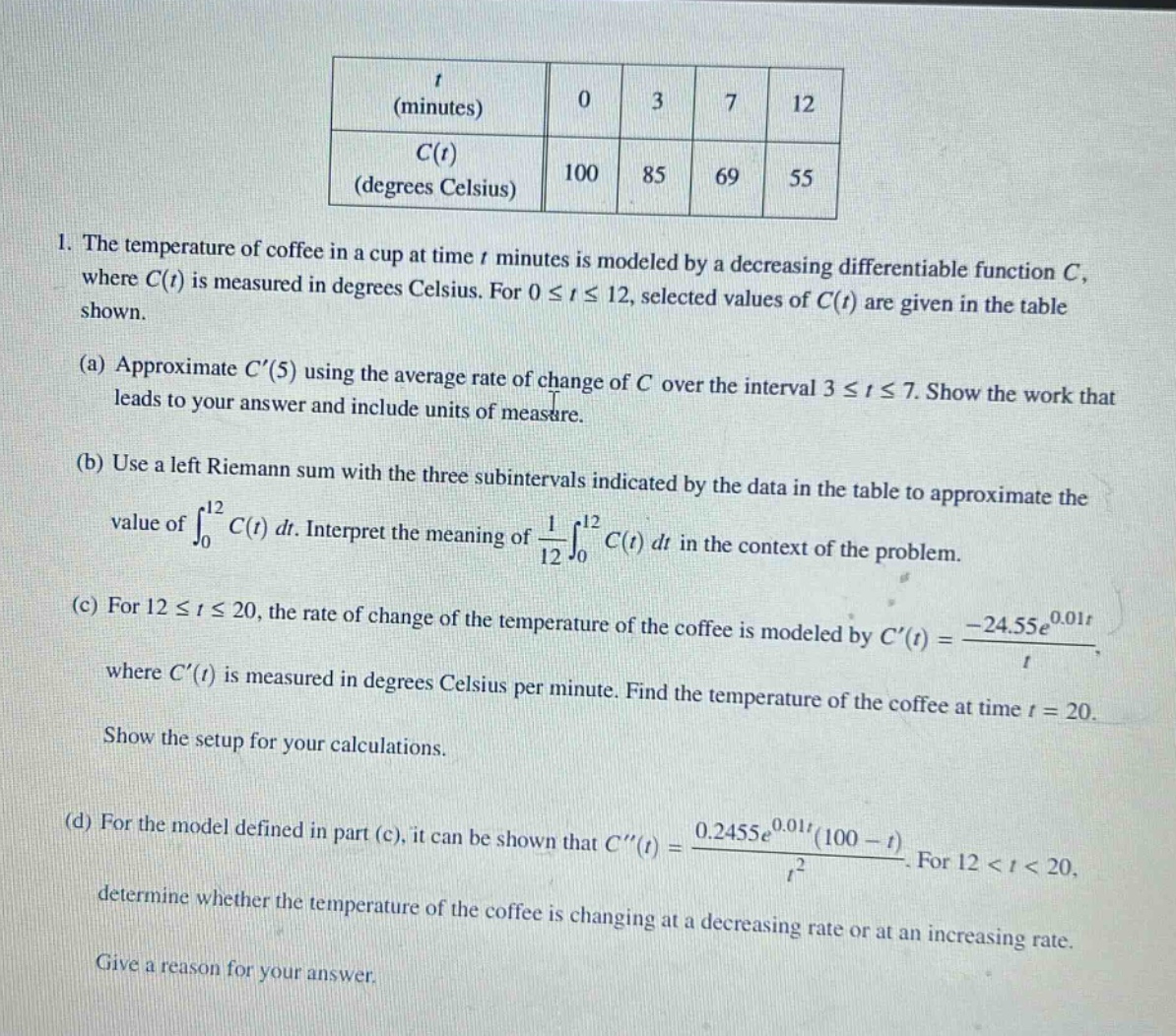
1. the temperature of coffee in a cup at time ( t ) minutes is modeled by a decreasing differentiable function ( c ), where ( c(t) ) is measured in degrees celsius. for ( 0 leq t leq 12 ), selected values of ( c(t) ) are given in the table shown.\n(a) approximate ( c^{prime}(5) ) using the average rate of change of ( c ) over the interval ( 3 leq t leq 7 ). show the work that leads to your answer and include units of measure.\n(b) use a left riemann sum with the three subintervals indicated by the data in the table to approximate the value of ( int_{0}^{12} c(t) d t ). interpret the meaning of ( \frac{1}{12} int_{0}^{12} c(t) d t ) in the context of the problem.\n(c) for ( 12 leq t leq 20 ), the rate of change of the temperature of the coffee is modeled by ( c^{prime}(t)=\frac{-24.55 e^{0.01 t}}{t} ), where ( c^{prime}(t) ) is measured in degrees celsius per minute. find the temperature of the coffee at time ( t = 20 ). show the setup for your calculations.\n(d) for the model defined in part (c), it can be shown that ( c^{prime prime}(t)=\frac{0.2455 e^{0.01 t}(100 - t)}{t^{2}} ). for ( 12 < t < 20 ), determine whether the temperature of the coffee is changing at a decreasing rate or at an increasing rate. give a reason for your answer.
Answer
Part (a)
Explanation:
Step1: Recall the average rate of change formula
The average rate of change of a function (y = C(t)) over the interval ([a,b]) is (\frac{C(b)-C(a)}{b - a}). Here, (a = 3), (b=7), (C(3)=85), and (C(7)=69). [ \frac{C(7)-C(3)}{7 - 3}=\frac{69 - 85}{7-3} ]
Step2: Calculate the value
[ \frac{69 - 85}{7 - 3}=\frac{-16}{4}=- 4 ] The units of (C^{\prime}(t)) are degrees Celsius per minute.
Answer:
(C^{\prime}(5)\approx - 4) degrees Celsius per minute.
Part (b)
Explanation:
Step1: Recall the left - Riemann sum formula
For a function (y = C(t)) on the interval ([a,b]) divided into (n) sub - intervals ([x_{0},x_{1}],[x_{1},x_{2}],\cdots,[x_{n - 1},x_{n}]) with (\Delta x_{i}=x_{i}-x_{i - 1}), the left - Riemann sum (L=\sum_{i = 1}^{n}C(x_{i-1})\Delta x_{i}). Here, (a = 0), (b = 12), (n = 3), (\Delta x_{1}=3-0 = 3), (\Delta x_{2}=7 - 3=4), (\Delta x_{3}=12 - 7 = 5), (C(0)=100), (C(3)=85), (C(7)=69) [ \int_{0}^{12}C(t)dt\approx C(0)(3 - 0)+C(3)(7 - 3)+C(7)(12 - 7) ]
Step2: Calculate the left - Riemann sum
[ \begin{align*} \int_{0}^{12}C(t)dt&\approx100\times3+85\times4 + 69\times5\ &=300+340+345\ &=985 \end{align*} ] The integral (\int_{0}^{12}C(t)dt) represents the total change in the temperature of the coffee (in degree - Celsius - minutes) over the first (12) minutes. Then (\frac{1}{12}\int_{0}^{12}C(t)dt) represents the average temperature (in degrees Celsius) of the coffee over the interval (0\leq t\leq12) minutes.
Answer:
(\int_{0}^{12}C(t)dt\approx985). (\frac{1}{12}\int_{0}^{12}C(t)dt) represents the average temperature of the coffee over the first (12) minutes.
Part (c)
Explanation:
Step1: Use the fundamental theorem of calculus
We know that (C(t)=C(12)+\int_{12}^{20}C^{\prime}(t)dt). Given (C(12) = 55) and (C^{\prime}(t)=\frac{-24.55e^{0.01t}}{t}) [ C(20)=55+\int_{12}^{20}\frac{-24.55e^{0.01t}}{t}dt ]
Answer:
(C(20)=55+\int_{12}^{20}\frac{-24.55e^{0.01t}}{t}dt)
Part (d)
Explanation:
Step1: Analyze the sign of (C^{\prime\prime}(t))
For (12\lt t\lt20), we have (C^{\prime\prime}(t)=\frac{0.2455e^{0.01t}(100 - t)}{t^{2}}). Since (e^{0.01t}>0) for all (t), (t^{2}>0) for (t\neq0), and when (12\lt t\lt20), (100 - t>0)
Answer:
The temperature of the coffee is changing at an increasing rate. Because for (12\lt t\lt20), (C^{\prime\prime}(t)=\frac{0.2455e^{0.01t}(100 - t)}{t^{2}}>0) (since (e^{0.01t}>0), (t^{2}>0), and (100 - t>0) in the interval (12\lt t\lt20)), and (C^{\prime\prime}(t)>0) implies that the function (C^{\prime}(t)) (the rate of change of (C(t))) is increasing.