5. the temperature during the day can be approximated using sinusoidal function. at 4 am the temperature was…
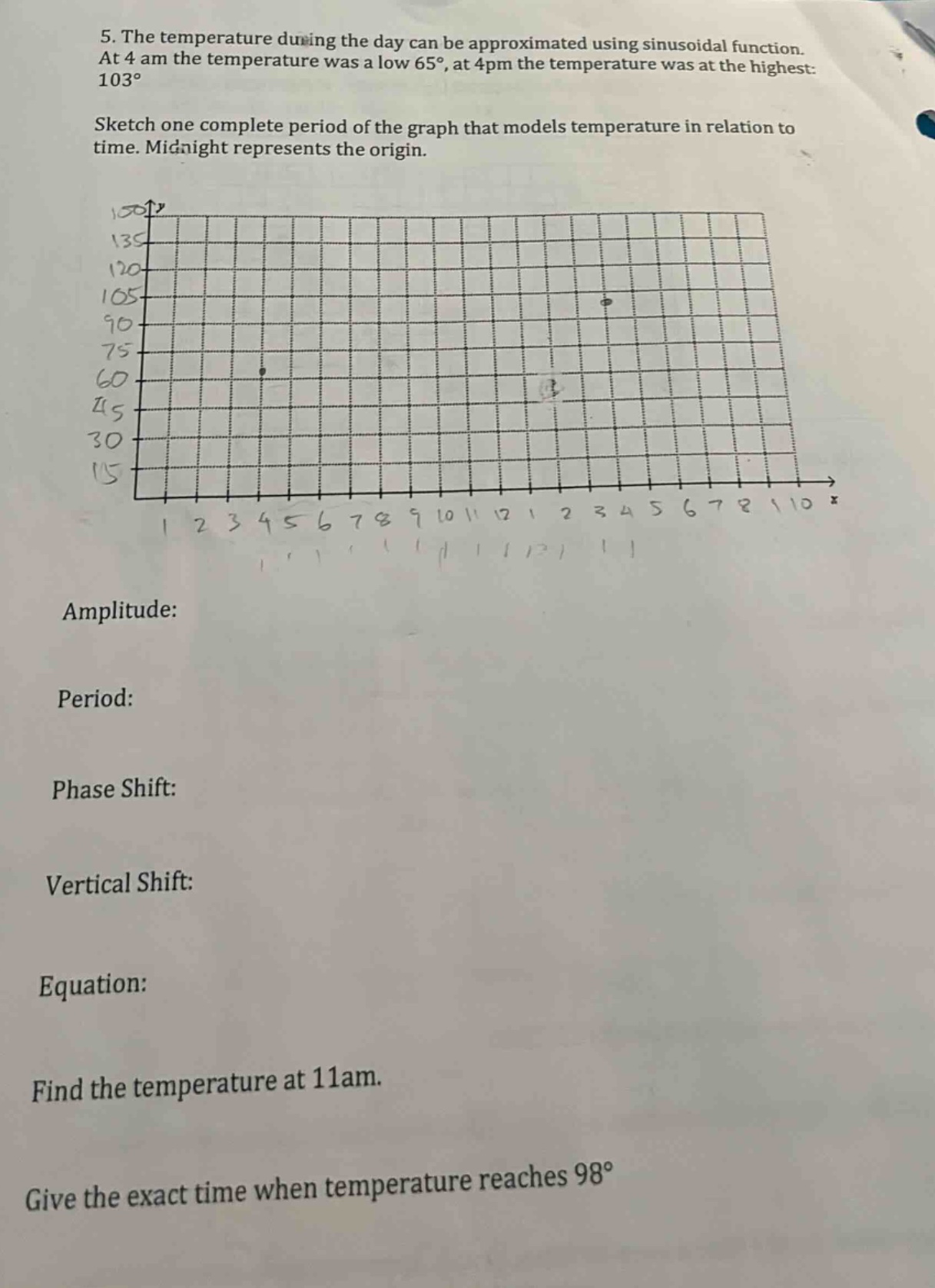
5. the temperature during the day can be approximated using sinusoidal function. at 4 am the temperature was a low 65°, at 4pm the temperature was at the highest: 103° sketch one complete period of the graph that models temperature in relation to time. midnight represents the origin. amplitude: period: phase shift: vertical shift: equation: find the temperature at 11am. give the exact time when temperature reaches 98°
Answer
Explanation:
Step1: Calculate amplitude
Amplitude $A=\frac{\text{Max}-\text{Min}}{2}=\frac{103 - 65}{2}=\frac{38}{2}=19$.
Step2: Determine period
The time from 4 am to 4 pm is 12 hours, which is half - period. So the period $T = 24$ hours. Since $T=\frac{2\pi}{B}$, and $T = 24$, then $B=\frac{2\pi}{24}=\frac{\pi}{12}$.
Step3: Find phase shift
The minimum occurs at $x = 4$ am. For a sine function $y = A\sin(B(x - C))+D$, the minimum of $y=\sin u$ occurs at $u=\frac{3\pi}{2}+2k\pi$. Let $u = B(x - C)$, when $x = 4$ and $B=\frac{\pi}{12}$, we have $\frac{\pi}{12}(4 - C)=\frac{3\pi}{2}$. Solving for $C$: [ \begin{align*} \frac{\pi}{12}(4 - C)&=\frac{3\pi}{2}\ 4 - C&=\frac{3\pi}{2}\times\frac{12}{\pi}\ 4 - C& = 18\ C&=- 14 \end{align*} ] The phase - shift is 14 hours.
Step4: Calculate vertical shift
The vertical shift $D=\frac{\text{Max}+\text{Min}}{2}=\frac{103 + 65}{2}=84$.
Step5: Write the equation
The sinusoidal equation is $y = 19\sin\left(\frac{\pi}{12}(x + 14)\right)+84$.
Step6: Find temperature at 11 am
At 11 am, $x = 11$. Substitute $x = 11$ into the equation: [ \begin{align*} y&=19\sin\left(\frac{\pi}{12}(11 + 14)\right)+84\ &=19\sin\left(\frac{\pi}{12}\times25\right)+84\ &=19\sin\left(\frac{25\pi}{12}\right)+84\ &=19\sin\left(2\pi+\frac{\pi}{12}\right)+84\ &=19\sin\left(\frac{\pi}{12}\right)+84 \end{align*} ] Since $\sin\left(\frac{\pi}{12}\right)=\frac{\sqrt{6}-\sqrt{2}}{4}\approx0.259$, then $y = 19\times0.259+84=84 + 4.921=88.921^{\circ}$.
Step7: Find time when temperature is 98°
Set $y = 98$, then $98=19\sin\left(\frac{\pi}{12}(x + 14)\right)+84$. [ \begin{align*} 19\sin\left(\frac{\pi}{12}(x + 14)\right)&=98 - 84\ 19\sin\left(\frac{\pi}{12}(x + 14)\right)&=14\ \sin\left(\frac{\pi}{12}(x + 14)\right)&=\frac{14}{19}\approx0.737 \end{align*} ] $\frac{\pi}{12}(x + 14)=\sin^{- 1}(0.737)$ or $\pi-\sin^{- 1}(0.737)$. Case 1: $\frac{\pi}{12}(x + 14)=\sin^{- 1}(0.737)\approx0.823$ [ \begin{align*} x+14&=\frac{0.823\times12}{\pi}\ x+14&\approx3.15\ x&\approx - 10.85 \end{align*} ] Case 2: $\frac{\pi}{12}(x + 14)=\pi - 0.823\approx2.319$ [ \begin{align*} x + 14&=\frac{2.319\times12}{\pi}\ x+14&\approx8.85\ x&\approx - 5.15 \end{align*} ] Since $x$ represents time after midnight, we add 24 if $x<0$. For the first solution $x\approx - 10.85+24 = 13.15$ (1:09 pm) For the second solution $x\approx - 5.15+24=18.85$ (6:51 pm)
Amplitude: $19$ Period: $24$ Phase Shift: $14$ Vertical Shift: $84$ Equation: $y = 19\sin\left(\frac{\pi}{12}(x + 14)\right)+84$ Temperature at 11 am: Approximately $88.921^{\circ}$ Times when temperature is $98^{\circ}$: Approximately 1:09 pm and 6:51 pm
Answer:
Amplitude: 19 Period: 24 Phase Shift: 14 Vertical Shift: 84 Equation: $y = 19\sin\left(\frac{\pi}{12}(x + 14)\right)+84$ Temperature at 11 am: $\approx88.921^{\circ}$ Times when temperature is $98^{\circ}$: Approximately 1:09 pm and 6:51 pm