a tennis ball was 2 feet off the ground when a tennis player hit it so that the ball traveled up in the air…
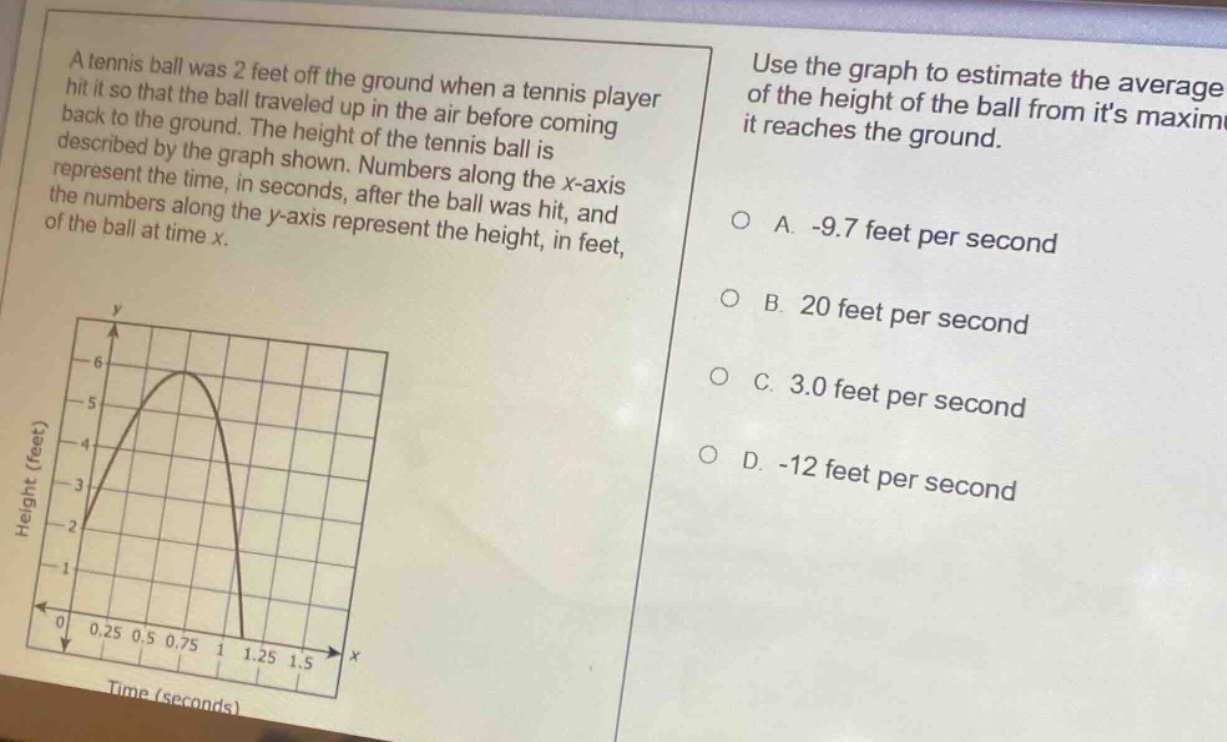
a tennis ball was 2 feet off the ground when a tennis player hit it so that the ball traveled up in the air before coming back to the ground. the height of the tennis ball is described by the graph shown. numbers along the x - axis represent the time, in seconds, after the ball was hit, and the numbers along the y - axis represent the height, in feet, of the ball at time x. use the graph to estimate the average of the height of the ball from its maximum it reaches the ground. a. -9.7 feet per second b. 20 feet per second c. 3.0 feet per second d. -12 feet per second
Answer
Explanation:
Step1: Identify time at maximum - height and ground - time
From the graph, the time at maximum height is around $x = 0.5$ seconds and the time when the ball reaches the ground is around $x = 1.25$ seconds. The maximum height is around $y = 6$ feet and the height at the ground is $y = 0$ feet.
Step2: Calculate the change in height and time
The change in height $\Delta y=0 - 6=- 6$ feet. The change in time $\Delta x=1.25 - 0.5 = 0.75$ seconds.
Step3: Calculate the average rate of change
The average rate of change of height (average velocity in this context) is given by the formula $\text{Average rate}=\frac{\Delta y}{\Delta x}$. So, $\frac{-6}{0.75}=-8$ feet per second. Since we are estimating from the graph, the closest value to our estimate is - 9.7 feet per second.
Answer:
A. -9.7 feet per second