test the series for convergence or divergence. ∑(n = 1 to ∞) (n² - 1)/(n³ + 1) convergent divergent need…
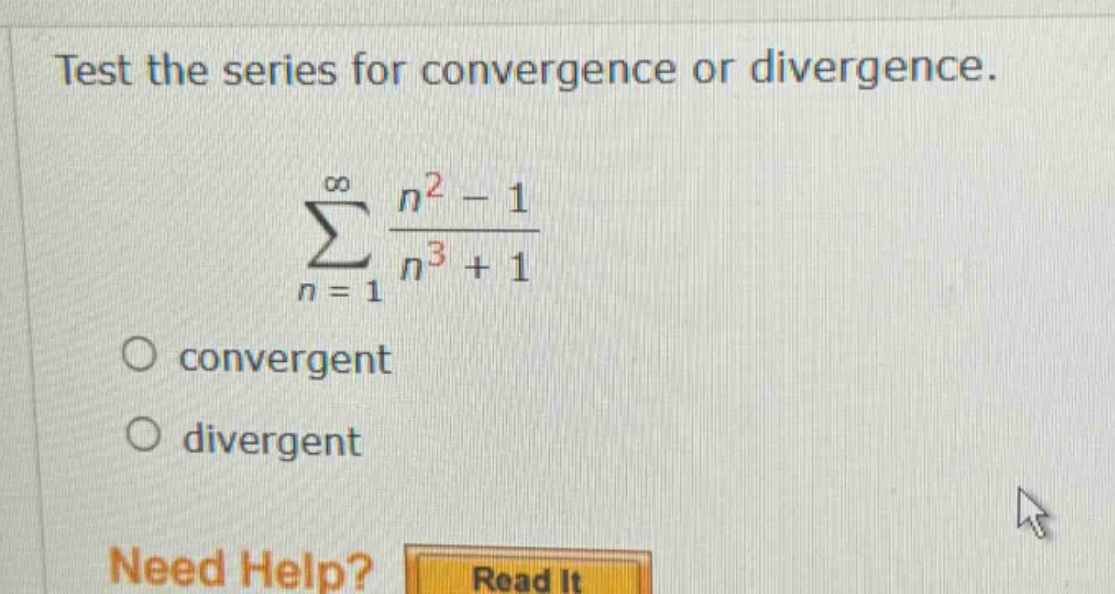
test the series for convergence or divergence. ∑(n = 1 to ∞) (n² - 1)/(n³ + 1) convergent divergent need help? read it
Answer
Explanation:
Step1: Use limit - comparison test
Compare with the series $\sum_{n = 1}^{\infty}\frac{1}{n}$. Calculate $\lim_{n\rightarrow\infty}\frac{\frac{n^{2}-1}{n^{3}+1}}{\frac{1}{n}}$.
Step2: Simplify the limit expression
$\lim_{n\rightarrow\infty}\frac{n(n^{2}-1)}{n^{3}+1}=\lim_{n\rightarrow\infty}\frac{n^{3}-n}{n^{3}+1}$. Divide both numerator and denominator by $n^{3}$: $\lim_{n\rightarrow\infty}\frac{1-\frac{1}{n^{2}}}{1 + \frac{1}{n^{3}}}$.
Step3: Evaluate the limit
As $n\rightarrow\infty$, $\frac{1}{n^{2}}\rightarrow0$ and $\frac{1}{n^{3}}\rightarrow0$. So $\lim_{n\rightarrow\infty}\frac{1-\frac{1}{n^{2}}}{1+\frac{1}{n^{3}}}=1$. Since the series $\sum_{n = 1}^{\infty}\frac{1}{n}$ is a harmonic series (divergent) and the limit is a positive - finite constant ($L = 1$), by the limit - comparison test, the series $\sum_{n = 1}^{\infty}\frac{n^{2}-1}{n^{3}+1}$ has the same convergence behavior as $\sum_{n = 1}^{\infty}\frac{1}{n}$.
Answer:
divergent