test yourself! practice tool\nthe function ( g(x)=f(x + 3)+2 ). which of the following is true of the graph…
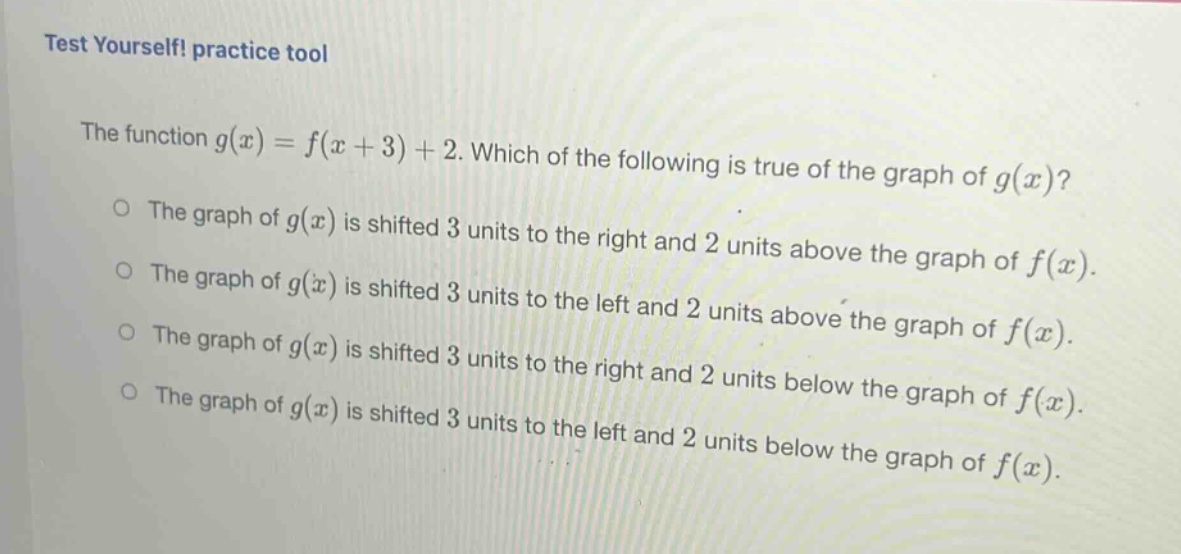
test yourself! practice tool\nthe function ( g(x)=f(x + 3)+2 ). which of the following is true of the graph of ( g(x) )?\nthe graph of ( g(x) ) is shifted 3 units to the right and 2 units above the graph of ( f(x) ).\nthe graph of ( g(x) ) is shifted 3 units to the left and 2 units above the graph of ( f(x) ).\nthe graph of ( g(x) ) is shifted 3 units to the right and 2 units below the graph of ( f(x) ).\nthe graph of ( g(x) ) is shifted 3 units to the left and 2 units below the graph of ( f(x) ).
Answer
Explanation:
Step1: Horizontal shift rule
For a function (y = f(x + h)), if (h>0), the graph shifts (h) units to the left. Here (h = 3) in (g(x)=f(x + 3)+2), so the graph of (f(x)) shifts 3 units to the left.
Step2: Vertical shift rule
For a function (y=f(x)+k), if (k>0), the graph shifts (k) units up. Here (k = 2) in (g(x)=f(x + 3)+2), so the graph shifts 2 units up.
Answer:
The graph of (g(x)) is shifted 3 units to the left and 2 units above the graph of (f(x)).