theorem (mvt) if f is a function defined on a, b that satisfies the following assumptions i) f is continuous…
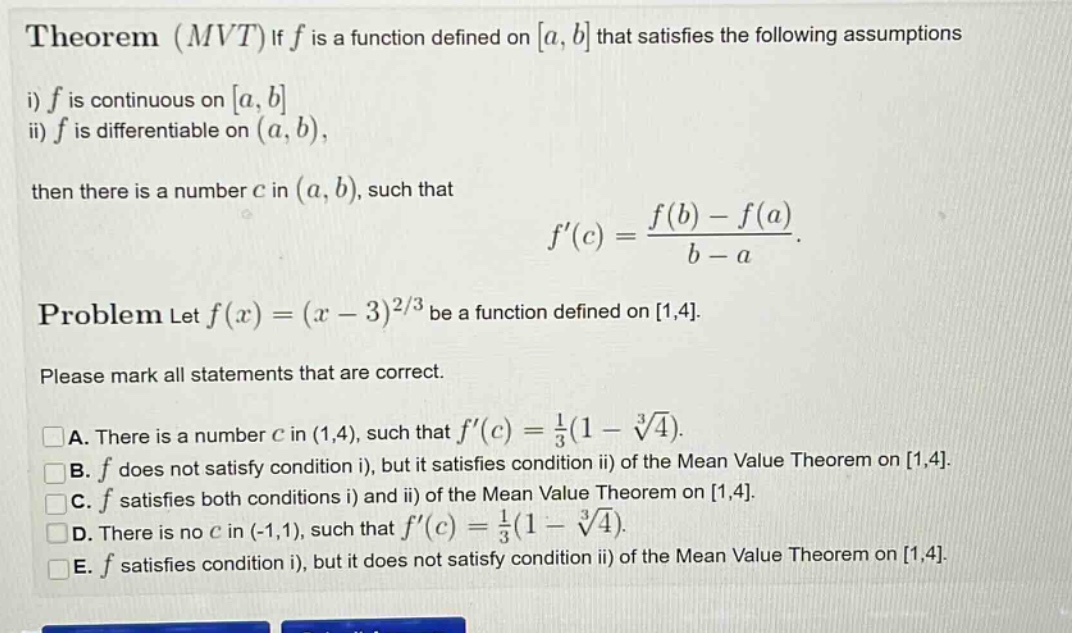
theorem (mvt) if f is a function defined on a, b that satisfies the following assumptions i) f is continuous on a, b ii) f is differentiable on (a, b), then there is a number c in (a, b), such that f(c) = (f(b) - f(a))/(b - a). problem let f(x) = (x - 3)^(2/3) be a function defined on 1,4. please mark all statements that are correct. a. there is a number c in (1,4), such that f(c) = 1/3(1 - ∛4). b. f does not satisfy condition i), but it satisfies condition ii) of the mean value theorem on 1,4. c. f satisfies both conditions i) and ii) of the mean value theorem on 1,4. d. there is no c in (-1,1), such that f(c) = 1/3(1 - ∛4). e. f satisfies condition i), but it does not satisfy condition ii) of the mean value theorem on 1,4.
Answer
Explanation:
Step1: Check continuity
The function $f(x)=(x - 3)^{2/3}$ is a composition of a power - function and a linear function. The cube - root function and polynomial functions are continuous everywhere. So, $f(x)$ is continuous on the closed interval $[1,4]$.
Step2: Check differentiability
Find the derivative of $f(x)$ using the chain - rule. Let $u=x - 3$, then $y = u^{2/3}$. The derivative $y^\prime=\frac{dy}{du}\cdot\frac{du}{dx}$. We know that $\frac{dy}{du}=\frac{2}{3}u^{-1/3}$ and $\frac{du}{dx}=1$, so $f^\prime(x)=\frac{2}{3(x - 3)^{1/3}}$. The derivative does not exist at $x = 3\in(1,4)$. So, $f(x)$ is not differentiable on the open interval $(1,4)$.
Step3: Analyze option A
First, find $f(1)=(1 - 3)^{2/3}=4^{1/3}$ and $f(4)=(4 - 3)^{2/3}=1$. Then $\frac{f(4)-f(1)}{4 - 1}=\frac{1 - 4^{1/3}}{3}$. Since $f(x)$ does not satisfy the MVT, we cannot directly say there is a $c\in(1,4)$ such that $f^\prime(c)=\frac{1}{3}(1-\sqrt[3]{4})$. But we can also note that the non - differentiability at $x = 3$ means we can't apply MVT.
Step4: Analyze option B
$f(x)$ is continuous on $[1,4]$, so it does not satisfy this option.
Step5: Analyze option C
Since $f(x)$ is not differentiable on $(1,4)$ (due to non - existence of derivative at $x = 3$), it does not satisfy both conditions of MVT.
Step6: Analyze option D
The interval $(-1,1)$ is not relevant to the problem as the function is defined on $[1,4]$.
Step7: Analyze option E
$f(x)$ is continuous on $[1,4]$ but not differentiable on $(1,4)$ because $f^\prime(x)=\frac{2}{3(x - 3)^{1/3}}$ is undefined at $x = 3\in(1,4)$. This option is correct.
Answer:
E. $f$ satisfies condition i), but it does not satisfy condition ii) of the Mean Value Theorem on $[1,4]$.