theorem (rolles theorem) if f is a function defined on a, b that satisfies the following assumptions i) f is…
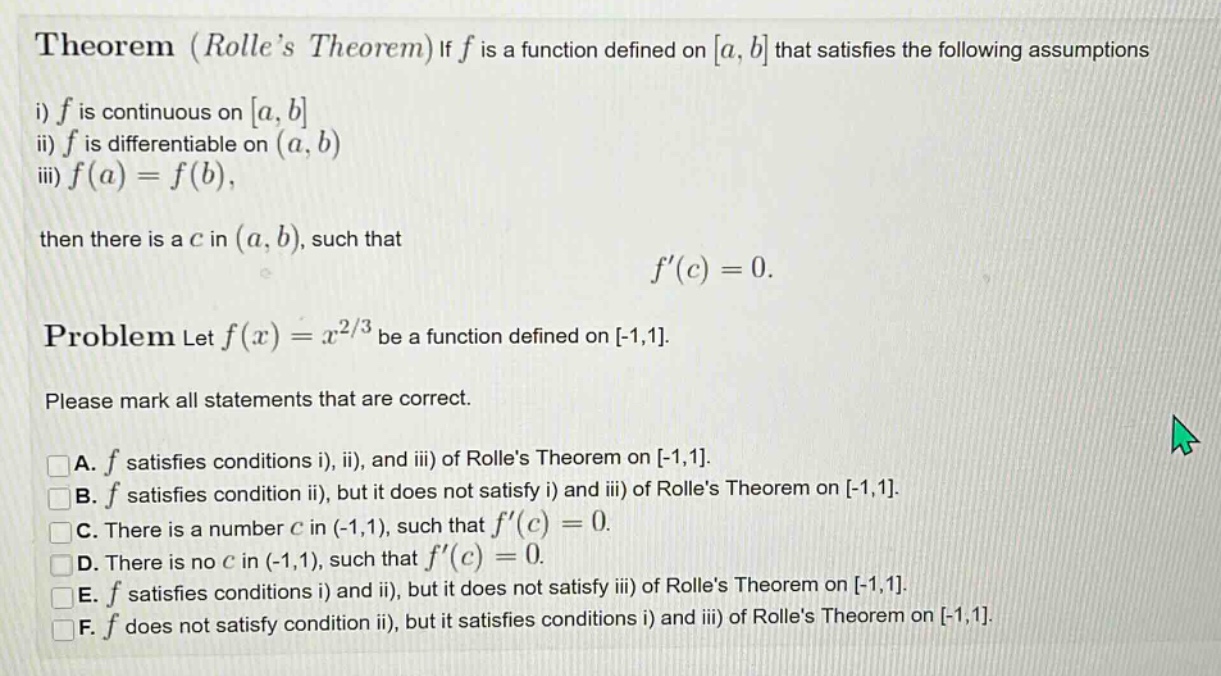
theorem (rolles theorem) if f is a function defined on a, b that satisfies the following assumptions i) f is continuous on a, b ii) f is differentiable on (a, b) iii) f(a)=f(b), then there is a c in (a, b), such that f(c)=0. problem let f(x)=x^2/3 be a function defined on -1,1. please mark all statements that are correct. a. f satisfies conditions i), ii), and iii) of rolles theorem on -1,1. b. f satisfies condition ii), but it does not satisfy i) and iii) of rolles theorem on -1,1. c. there is a number c in (-1,1), such that f(c)=0. d. there is no c in (-1,1), such that f(c)=0. e. f satisfies conditions i) and ii), but it does not satisfy iii) of rolles theorem on -1,1. f. f does not satisfy condition ii), but it satisfies conditions i) and iii) of rolles theorem on -1,1.
Answer
Explanation:
Step1: Check continuity
The function $f(x)=x^{2/3}$ is continuous on $[-1,1]$ since $\lim_{x\rightarrow x_0}x^{2/3}=x_0^{2/3}$ for all $x_0\in[-1,1]$.
Step2: Check differentiability
Find the derivative $f'(x)=\frac{2}{3}x^{-1/3}=\frac{2}{3\sqrt[3]{x}}$. It is not defined at $x = 0\in(-1,1)$, so $f(x)$ is not differentiable on $(-1,1)$.
Step3: Check $f(a)=f(b)$
$f(-1)=(-1)^{2/3}=1$ and $f(1)=1^{2/3}=1$, so $f(-1)=f(1)$.
Step4: Analyze statements
Since $f(x)$ is continuous on $[-1,1]$, not differentiable on $(-1,1)$ and $f(-1)=f(1)$, it does not satisfy condition ii) but satisfies conditions i) and iii) of Rolle's Theorem. Also, since it does not satisfy all the conditions of Rolle's Theorem, we cannot guarantee the existence of a $c\in(-1,1)$ such that $f'(c)=0$. In fact, $f'(x)=\frac{2}{3\sqrt[3]{x}}\neq0$ for any real - valued $x$.
Answer:
D. There is no $c$ in $(-1,1)$, such that $f'(c)=0$; F. $f$ does not satisfy condition ii), but it satisfies conditions i) and iii) of Rolle's Theorem on $[-1,1]$.