a theorem states that one local extremum implies absolute extremum. verify that the following function…
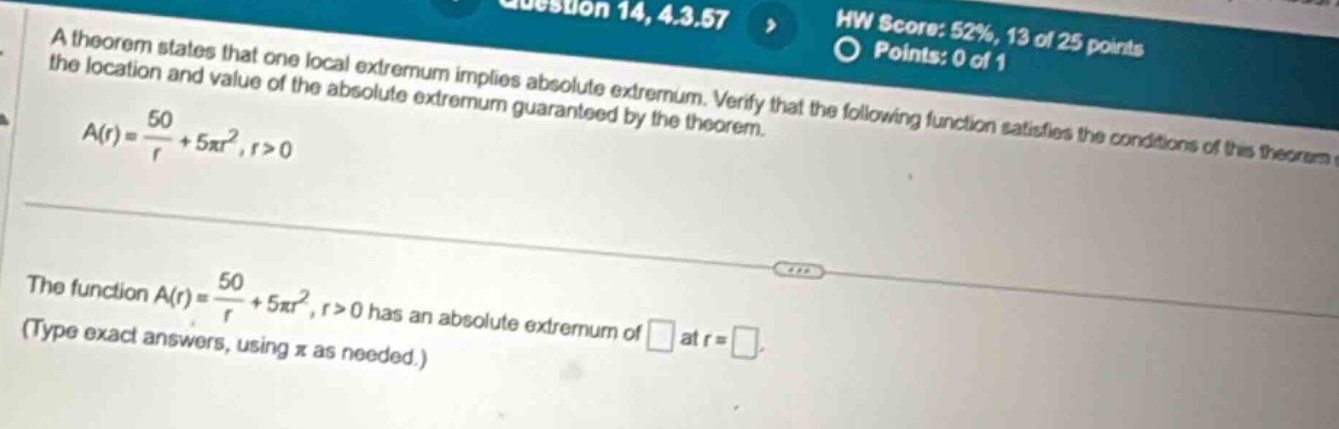
a theorem states that one local extremum implies absolute extremum. verify that the following function satisfies the conditions of the theorem and find the location and value of the absolute extremum guaranteed by the theorem. a(r)=50/r + 5πr²,r>0 the function a(r)=50/r + 5πr²,r>0 has an absolute extremum of at r= . (type exact answers, using π as needed.)
Answer
Explanation:
Step1: Find the derivative of A(r)
We have $A(r)=\frac{50}{r}+5\pi r^{2}=50r^{- 1}+5\pi r^{2}$. Using the power - rule $(x^n)^\prime=nx^{n - 1}$, the derivative $A^\prime(r)=-50r^{-2}+10\pi r=\frac{-50}{r^{2}} + 10\pi r$.
Step2: Set the derivative equal to zero
Set $A^\prime(r) = 0$, so $\frac{-50}{r^{2}}+10\pi r = 0$. Multiply through by $r^{2}$ (since $r>0$) to get $-50 + 10\pi r^{3}=0$. Then $10\pi r^{3}=50$, and $r^{3}=\frac{5}{\pi}$, so $r=\sqrt[3]{\frac{5}{\pi}}$.
Step3: Find the second - derivative of A(r)
Differentiate $A^\prime(r)=\frac{-50}{r^{2}}+10\pi r=-50r^{-2}+10\pi r$ with respect to $r$. Using the power - rule, $A^{\prime\prime}(r)=100r^{-3}+10\pi=\frac{100}{r^{3}}+10\pi$. Substitute $r = \sqrt[3]{\frac{5}{\pi}}$ into $A^{\prime\prime}(r)$: $A^{\prime\prime}(\sqrt[3]{\frac{5}{\pi}})=\frac{100}{\frac{5}{\pi}}+10\pi=20\pi + 10\pi=30\pi>0$. So $r=\sqrt[3]{\frac{5}{\pi}}$ is a local minimum.
Step4: Find the value of the absolute minimum
Substitute $r=\sqrt[3]{\frac{5}{\pi}}$ into $A(r)$: [ \begin{align*} A(\sqrt[3]{\frac{5}{\pi}})&=\frac{50}{\sqrt[3]{\frac{5}{\pi}}}+5\pi(\sqrt[3]{\frac{5}{\pi}})^{2}\ &=50(\frac{\pi}{5})^{\frac{1}{3}}+5\pi(\frac{5}{\pi})^{\frac{2}{3}}\ &=50(\frac{\pi}{5})^{\frac{1}{3}}+5\pi\times\frac{5^{\frac{2}{3}}}{\pi^{\frac{2}{3}}}\ &=50(\frac{\pi}{5})^{\frac{1}{3}}+25(\frac{\pi}{5})^{\frac{1}{3}}\ &=75(\frac{\pi}{5})^{\frac{1}{3}} \end{align*} ]
Answer:
The function $A(r)=\frac{50}{r}+5\pi r^{2},r > 0$ has an absolute extremum of $75(\frac{\pi}{5})^{\frac{1}{3}}$ at $r=\sqrt[3]{\frac{5}{\pi}}$.