a third - degree polynomial function has three real zeros, has a relative minimum at (2, - 3), and increases…
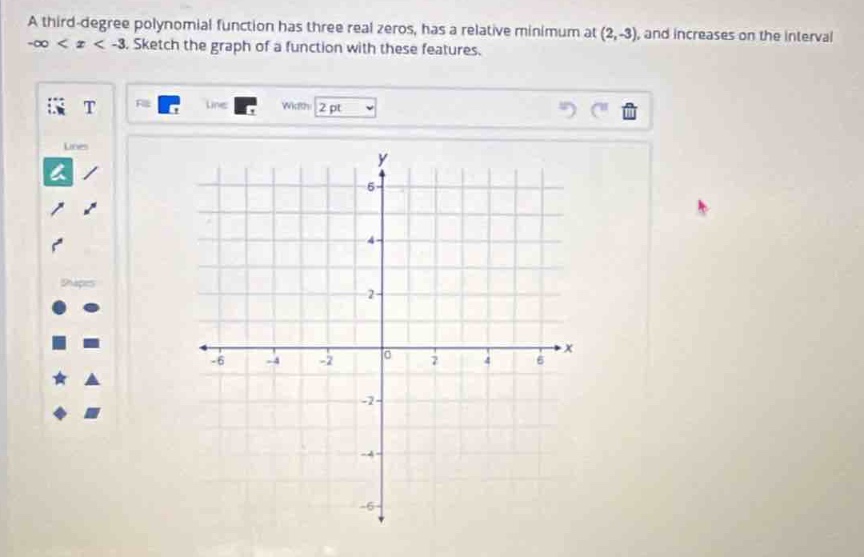
a third - degree polynomial function has three real zeros, has a relative minimum at (2, - 3), and increases on the interval -∞ < x < - 3. sketch the graph of a function with these features.
Answer
Explanation:
Step1: Analyze end - behavior
A third - degree polynomial with a positive leading coefficient increases on $(-\infty,- 3)$. So the leading coefficient is positive.
Step2: Mark the relative minimum
Mark the point $(2,-3)$ on the coordinate plane as it is a relative minimum.
Step3: Consider the zeros
Since it has three real zeros and we know its behavior and a relative minimum, we can start sketching. As $x\to-\infty$, $y\to-\infty$ (because of the positive leading - coefficient of the third - degree polynomial). The function increases on $(-\infty,-3)$, then it must turn around to reach the relative minimum at $(2,-3)$. After the relative minimum, it continues to increase as $x\to+\infty$. We can place the zeros such that the graph crosses the $x$ - axis three times while following the given behavior.
To sketch:
- Plot the point $(2,-3)$.
- Draw a curve that is increasing for $x < - 3$, then turns to reach the point $(2,-3)$ and then increases again for $x>2$. Make sure the curve crosses the $x$ - axis three times.
Answer:
Sketch the graph as described above with a positive - leading - coefficient third - degree polynomial that has three $x$ - intercepts, a relative minimum at $(2,-3)$ and is increasing on $x\in(-\infty,-3)$.