for time t > 0, the position of a particle moving in the xy - plane is given by the parametric equations x =…
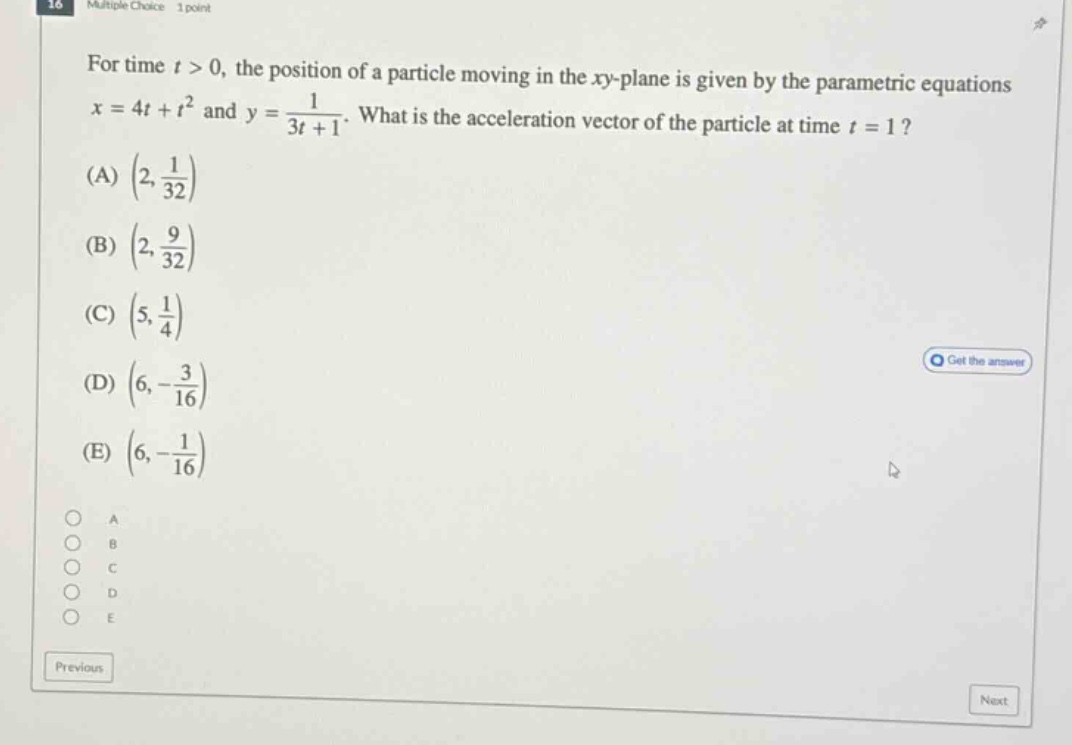
for time t > 0, the position of a particle moving in the xy - plane is given by the parametric equations x = 4t + t² and y = 1/(3t + 1). what is the acceleration vector of the particle at time t = 1? (a) (2, 1/32) (b) (2, 9/32) (c) (5, 1/4) (d) (6, - 3/16) (e) (6, - 1/16)
Answer
Answer:
B. $\left(2,\frac{9}{32}\right)$
Explanation:
Step1: Find the first - derivative of $x$ with respect to $t$
Differentiate $x = 4t+t^{2}$ using the power rule. $\frac{dx}{dt}=4 + 2t$.
Step2: Find the second - derivative of $x$ with respect to $t$
Differentiate $\frac{dx}{dt}=4 + 2t$ with respect to $t$. $\frac{d^{2}x}{dt^{2}}=2$.
Step3: Find the first - derivative of $y$ with respect to $t$
Use the quotient rule. If $y=\frac{1}{3t + 1}=(3t + 1)^{-1}$, then $\frac{dy}{dt}=-1\times(3t + 1)^{-2}\times3=-\frac{3}{(3t + 1)^{2}}$.
Step4: Find the second - derivative of $y$ with respect to $t$
Use the quotient rule or chain rule. $\frac{d^{2}y}{dt^{2}}=\frac{3\times2\times3}{(3t + 1)^{3}}=\frac{18}{(3t + 1)^{3}}$.
Step5: Evaluate the second - derivatives at $t = 1$
For $x$, $\frac{d^{2}x}{dt^{2}}\big|{t = 1}=2$. For $y$, $\frac{d^{2}y}{dt^{2}}\big|{t = 1}=\frac{18}{(3\times1+ 1)^{3}}=\frac{18}{64}=\frac{9}{32}$. The acceleration vector is $\left(\frac{d^{2}x}{dt^{2}},\frac{d^{2}y}{dt^{2}}\right)=\left(2,\frac{9}{32}\right)$ at $t = 1$.