at time t, 0 < t < 2, the velocity of a particle moving along the x - axis is given by v(t)=t sin(t²). let t…
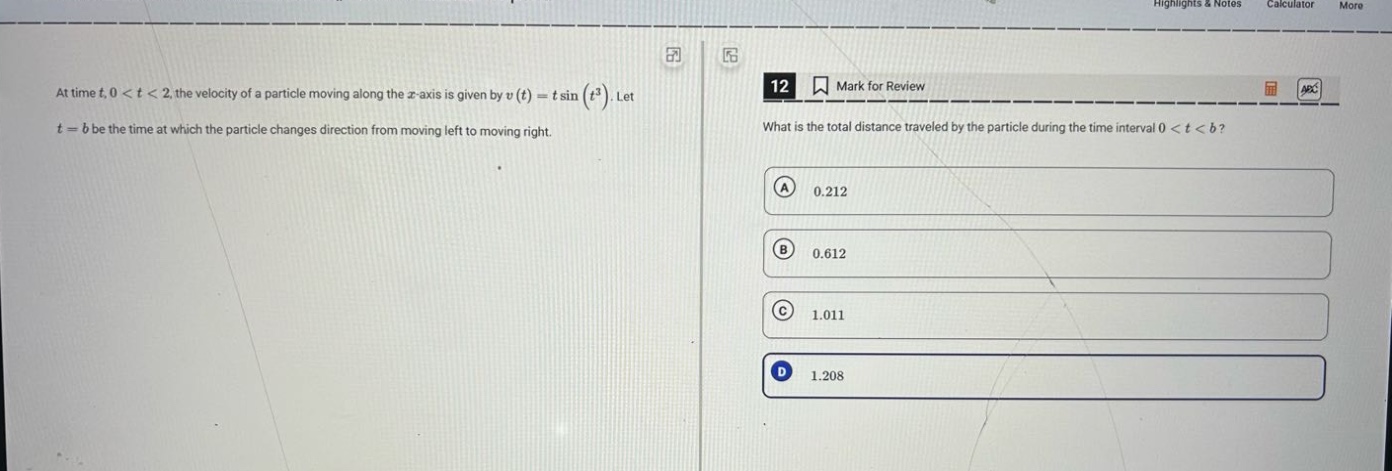
at time t, 0 < t < 2, the velocity of a particle moving along the x - axis is given by v(t)=t sin(t²). let t = b be the time at which the particle changes direction from moving left to moving right. 12 mark for review what is the total distance traveled by the particle during the time interval 0 < t < b? a 0.212 b 0.612 c 1.011 d 1.208
Answer
Explanation:
Step1: Find the time $b$
The particle changes direction when $v(t)$ changes sign. Set $v(t)=t\sin(t^{2}) = 0$. Since $t\in(0,2)$, then $t^{2}=k\pi$ ($k\in\mathbb{Z}$). For $t\in(0,2)$, when $k = 1$, $t^{2}=\pi$, so $t = b=\sqrt{\pi}\approx1.77$. The particle changes direction when $v(t)$ goes from negative to positive.
Step2: Recall the distance - velocity relationship
The distance $d$ traveled by a particle over the interval $[a,b]$ is given by $d=\int_{a}^{b}|v(t)|dt$. Since $v(t)=t\sin(t^{2})$ and for $t\in(0,\sqrt{\pi})$, we know that $v(t)$ is non - positive on some sub - intervals and non - negative on others. Let $u = t^{2}$, then $du=2tdt$ and $t\sin(t^{2})dt=\frac{1}{2}\sin(u)du$.
Step3: Evaluate the integral for distance
We need to evaluate $\int_{0}^{\sqrt{\pi}}|t\sin(t^{2})|dt$. Since $v(t)=t\sin(t^{2})$, and using the substitution $u = t^{2}$, when $t = 0$, $u = 0$; when $t=\sqrt{\pi}$, $u=\pi$. [ \begin{align*} \int_{0}^{\sqrt{\pi}}|t\sin(t^{2})|dt&=\int_{0}^{\sqrt{\pi}}| \frac{1}{2}\sin(u)|du\ &=\frac{1}{2}\int_{0}^{\pi}|\sin(u)|du \end{align*} ] We know that $\sin(u)\geq0$ for $u\in[0,\pi]$, so $\frac{1}{2}\int_{0}^{\pi}\sin(u)du$. [ \begin{align*} \frac{1}{2}[-\cos(u)]_{0}^{\pi}&=\frac{1}{2}[-\cos(\pi)+\cos(0)]\ &=\frac{1}{2}(1 + 1)\ &= 1 \end{align*} ] The closest value to $1$ among the options is $1.011$.
Answer:
C. 1.011