the tojolobal mayan indian community in southern mexico has available a fixed amount of land. the…
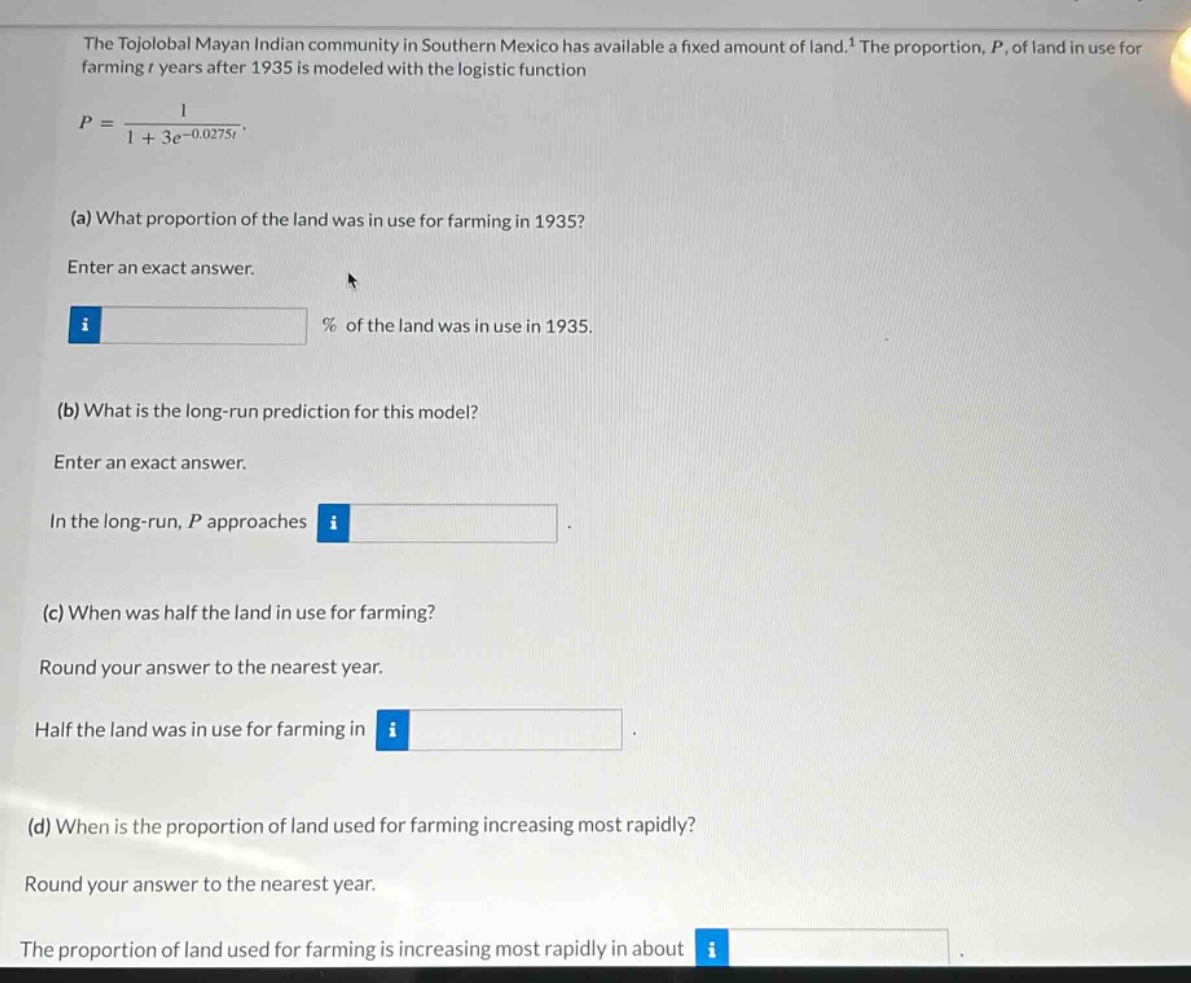
the tojolobal mayan indian community in southern mexico has available a fixed amount of land. the proportion, $p$, of land in use for farming $t$ years after 1935 is modeled with the logistic function $p=\frac{1}{1 + 3e^{-0.0275t}}$. (a) what proportion of the land was in use for farming in 1935? enter an exact answer. % of the land was in use in 1935. (b) what is the long - run prediction for this model? enter an exact answer. in the long - run, $p$ approaches. (c) when was half the land in use for farming? round your answer to the nearest year. half the land was in use for farming in. (d) when is the proportion of land used for farming increasing most rapidly? round your answer to the nearest year. the proportion of land used for farming is increasing most rapidly in about.
Answer
Explanation:
Step1: Find proportion in 1935
In 1935, (t = 0). Substitute (t=0) into (P=\frac{1}{1 + 3e^{-0.0275t}}). [P=\frac{1}{1+3e^{0}}=\frac{1}{1 + 3\times1}=\frac{1}{4}=0.25]
Step2: Long - run prediction
As (t\rightarrow\infty), (e^{-0.0275t}\rightarrow0). Then (P=\lim_{t\rightarrow\infty}\frac{1}{1 + 3e^{-0.0275t}}=\frac{1}{1+0}=1)
Step3: Find when half the land is in use
Set (P = 0.5), so (0.5=\frac{1}{1 + 3e^{-0.0275t}}). Cross - multiply: (0.5(1 + 3e^{-0.0275t})=1), then (1+3e^{-0.0275t}=2), (3e^{-0.0275t}=1), (e^{-0.0275t}=\frac{1}{3}). Take the natural logarithm of both sides: (-0.0275t=\ln(\frac{1}{3})=-\ln(3)), (t=\frac{\ln(3)}{0.0275}\approx39)
Step4: Find when rate of increase is maximum
For a logistic function (P=\frac{L}{1 + Ae^{-kt}}) (here (L = 1), (A = 3), (k=0.0275)), the maximum of the rate of change occurs at (t=\frac{\ln(A)}{k}). Substitute (A = 3) and (k = 0.0275): (t=\frac{\ln(3)}{0.0275}\approx39)
Answer:
(a) (25%) (b) (1) (c) (1935 + 39=1974) (d) (1974)