topic: amplitude and period\nprogress:\nthe movement of the progress bar may be uneven because questions can…
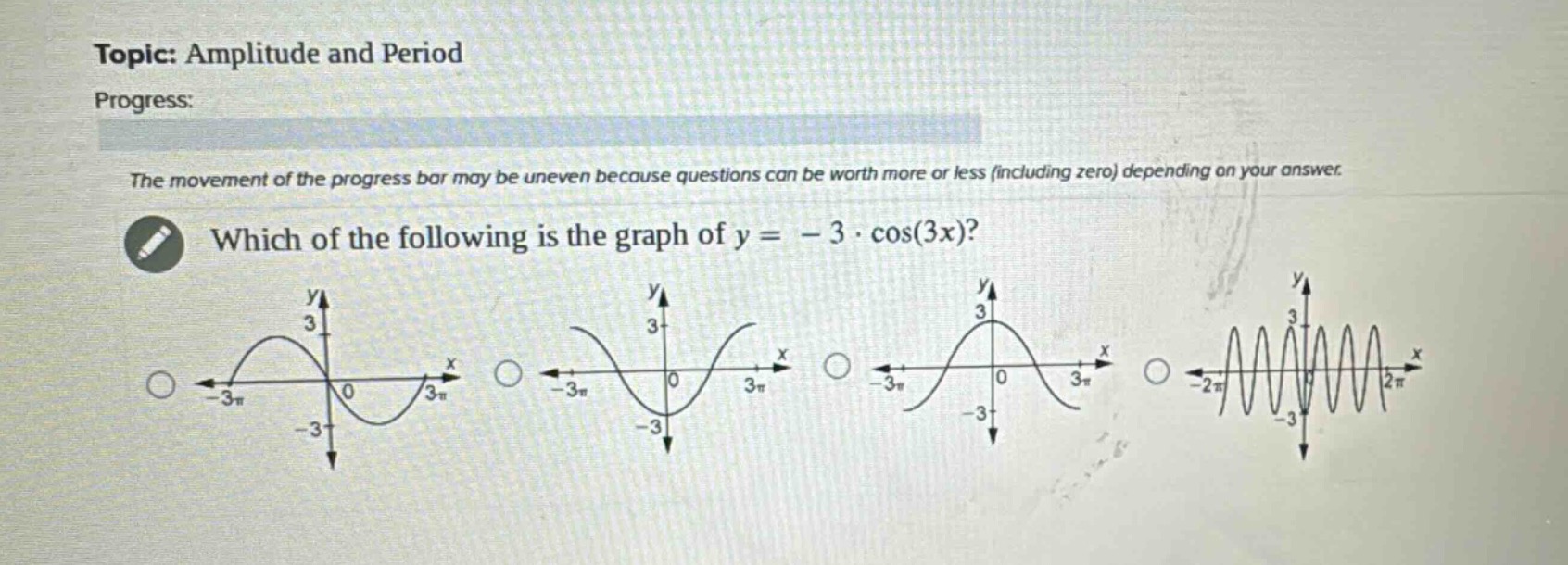
topic: amplitude and period\nprogress:\nthe movement of the progress bar may be uneven because questions can be worth more or less (including zero) depending on your answer.\nwhich of the following is the graph of $y = - 3cdotcos(3x)$?
Answer
Explanation:
Step1: Recall cosine - function form
The general form of a cosine function is $y = A\cos(Bx - C)+D$. For the function $y=-3\cos(3x)$, we have $A=-3$, $B = 3$, $C = 0$, and $D = 0$.
Step2: Determine the amplitude
The amplitude of the function $y = A\cos(Bx - C)+D$ is given by $|A|$. Here, $|A|=|-3| = 3$, so the graph oscillates between $y=-3$ and $y = 3$.
Step3: Determine the period
The period of the function $y=\cos(Bx)$ is $T=\frac{2\pi}{|B|}$. For $y=-3\cos(3x)$, since $B = 3$, the period $T=\frac{2\pi}{3}$.
Step4: Analyze the sign of $A$
Since $A=-3<0$, the graph of $y = \cos(3x)$ is reflected about the $x$ - axis.
The graph that has an amplitude of 3 (oscillates between - 3 and 3), a period of $\frac{2\pi}{3}$, and is reflected about the $x$ - axis is the correct one.
Answer:
The graph that has an amplitude of 3, a period of $\frac{2\pi}{3}$, and is reflected about the $x$ - axis among the given options. (Since no option - identifiers are given, a description of the correct graph is provided).