transform $y = \\cot(x)$ to get the graph of $y = 3\\cot\\left\\frac{1}{5}(x + 2)\\right$. which type of…
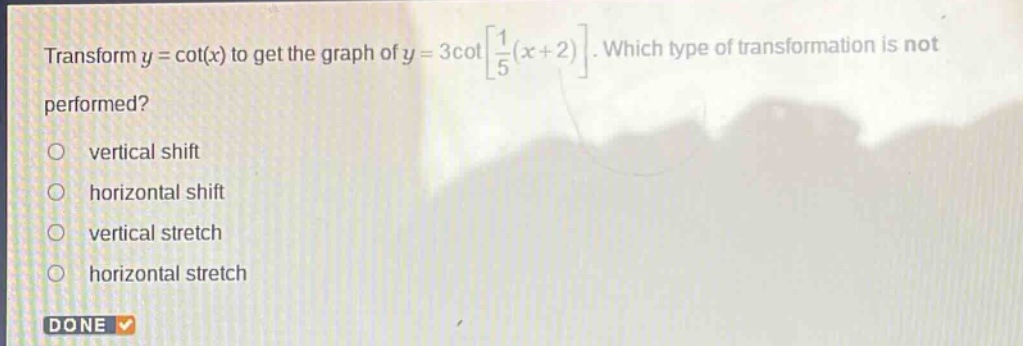
transform $y = \\cot(x)$ to get the graph of $y = 3\\cot\\left\\frac{1}{5}(x + 2)\\right$. which type of transformation is not performed?\nvertical shift\nhorizontal shift\nvertical stretch\nhorizontal stretch
Answer
Explanation:
Step1: Analyze the general form of transformations
For a function $y = a\cot(b(x - h))+k$, $a$ represents vertical - stretch or compression, $b$ represents horizontal - stretch or compression, $h$ represents horizontal shift, and $k$ represents vertical shift. For the function $y = 3\cot\left[\frac{1}{5}(x + 2)\right]$, compared with $y=\cot(x)$:
- The value of $a = 3$, so there is a vertical stretch by a factor of 3.
- The value of $b=\frac{1}{5}$, so there is a horizontal stretch by a factor of 5.
- The value of $h=- 2$, so there is a horizontal shift of 2 units to the left.
- Since there is no added constant term outside the cotangent function, there is no vertical shift.
Answer:
vertical shift