what does the transformation ( f(x)\to -f(x) ) do to the graph of ( f(x) )? reflects it across the ( y…
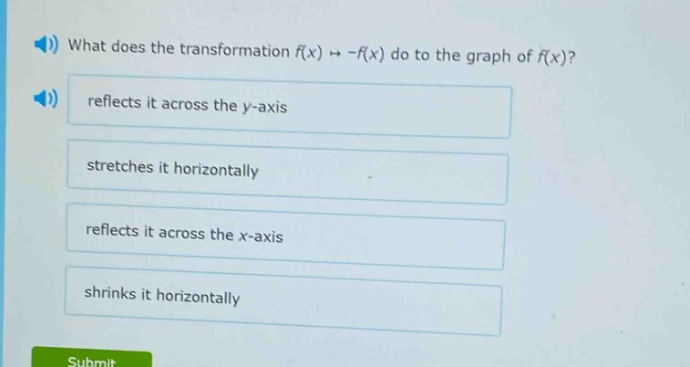
what does the transformation ( f(x)\to -f(x) ) do to the graph of ( f(x) )? reflects it across the ( y )-axis stretches it horizontally reflects it across the ( x )-axis shrinks it horizontally
Answer
Answer:
C. reflects it across the x - axis
Explanation:
Step1: Recall transformation rules
For a function (y = f(x)), when we consider (y=-f(x)). Let ((x,y)) be a point on the graph of (y = f(x)), so (y = f(x)). For the function (y=-f(x)), when (x) is the same, the new (y) - value is (-y).
Step2: Analyze the reflection
The transformation from ((x,y)) to ((x, - y)) is a reflection across the (x) - axis. For example, if (f(x)=x^{2}), (y = f(x)=x^{2}) (a parabola opening upwards) and (y=-f(x)=-x^{2}) (a parabola opening downwards). This is a reflection across the (x) - axis.
The transformation (f(x)\to f(-x)) reflects the graph across the (y) - axis. Horizontal stretching or shrinking is of the form (f(x)\to f(kx)) where (|k|\neq1). If (0 < |k|<1) it is a horizontal stretch and if (|k|> 1) it is a horizontal shrink.