which transformations are needed to change the parent cosine function to (y = 3cos(10(x-pi)))?\nvertical…
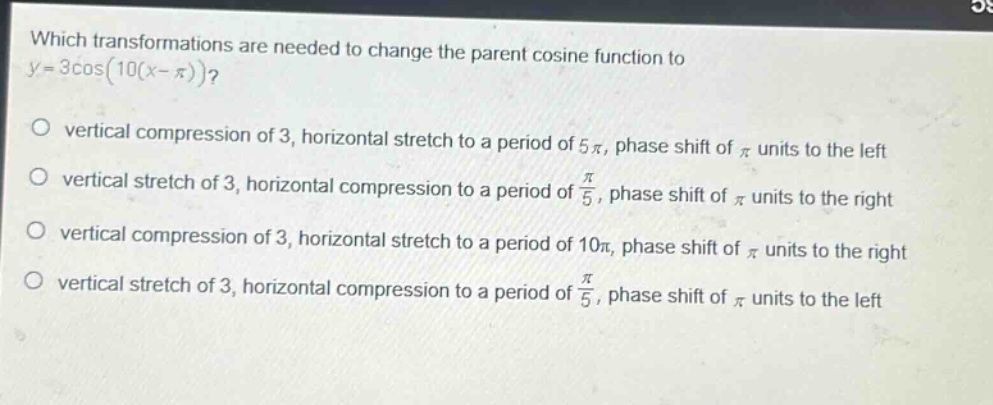
which transformations are needed to change the parent cosine function to (y = 3cos(10(x-pi)))?\nvertical compression of 3, horizontal stretch to a period of (5pi), phase shift of (pi) units to the left\nvertical stretch of 3, horizontal compression to a period of (\frac{pi}{5}), phase shift of (pi) units to the right\nvertical compression of 3, horizontal stretch to a period of (10pi), phase shift of (pi) units to the right\nvertical stretch of 3, horizontal compression to a period of (\frac{pi}{5}), phase shift of (pi) units to the left
Answer
Answer:
B. vertical stretch of 3, horizontal compression to a period of $\frac{\pi}{5}$, phase shift of $\pi$ units to the right
Explanation:
Step1: Analyze vertical transformation
The general form of a cosine - function is $y = A\cos(B(x - C))+D$. Here, $A = 3$. Since $|A|>1$, it represents a vertical stretch by a factor of 3.
Step2: Analyze horizontal transformation
The period of the parent cosine function $y=\cos(x)$ is $T_0 = 2\pi$. For the function $y=\cos(Bx)$, the period $T=\frac{2\pi}{B}$. In the given function $y = 3\cos(10(x-\pi))$, $B = 10$. So the period $T=\frac{2\pi}{10}=\frac{\pi}{5}$, which means a horizontal compression.
Step3: Analyze phase - shift
For the function $y = A\cos(B(x - C))+D$, the phase - shift is given by $C$. In the function $y = 3\cos(10(x-\pi))$, $C=\pi$. A positive $C$ value represents a phase - shift of $\pi$ units to the right.