trig graph applications class examples\n1) as you ride a ferris wheel, the height that you are above the…
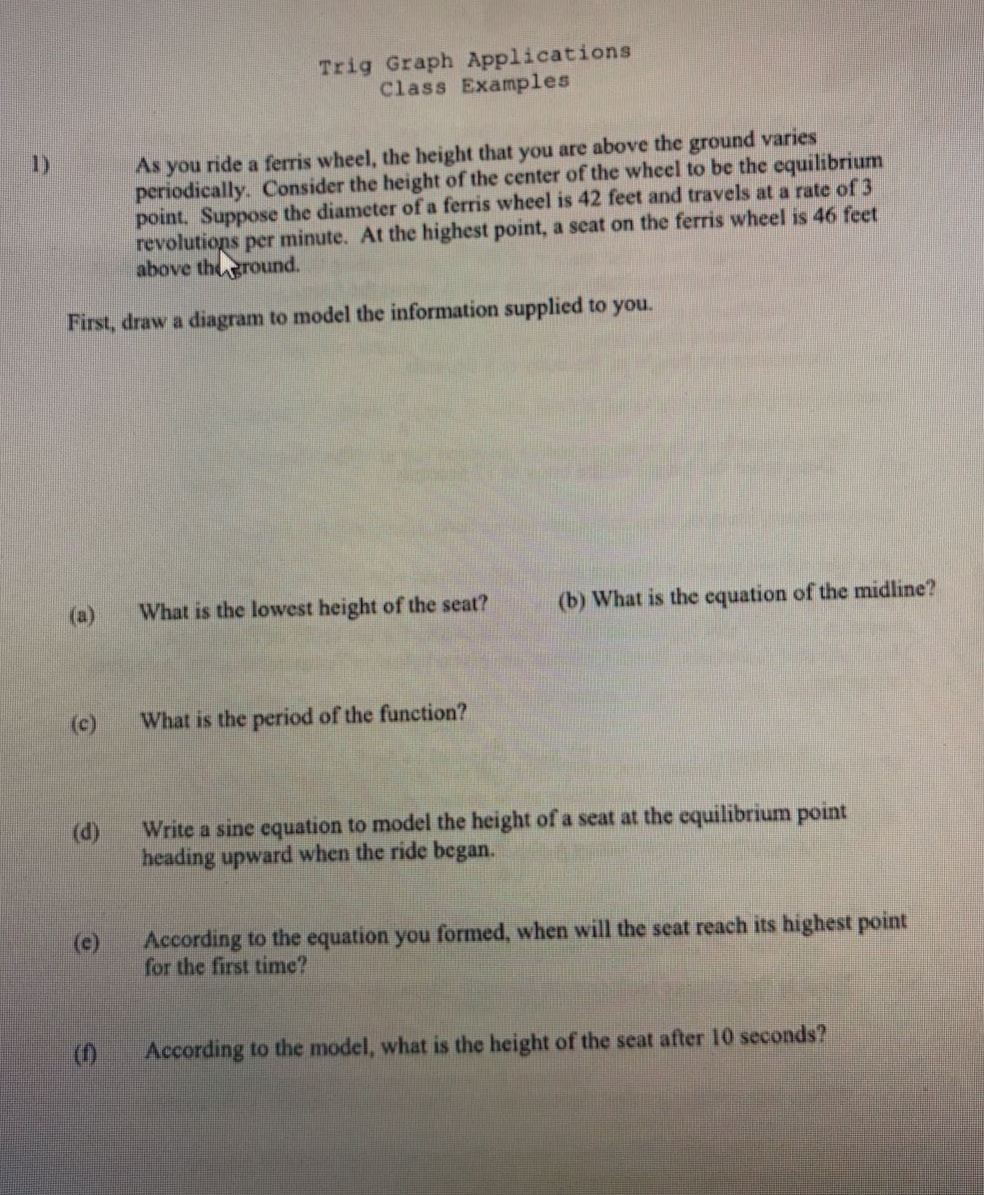
trig graph applications class examples\n1) as you ride a ferris wheel, the height that you are above the ground varies periodically. consider the height of the center of the wheel to be the equilibrium point. suppose the diameter of a ferris wheel is 42 feet and travels at a rate of 3 revolutions per minute. at the highest point, a seat on the ferris wheel is 46 feet above the ground.\nfirst, draw a diagram to model the information supplied to you.\n(a) what is the lowest height of the seat? (b) what is the equation of the mid - line?\n(c) what is the period of the function?\n(d) write a sine equation to model the height of a seat at the equilibrium point heading upward when the ride began.\n(e) according to the equation you formed, when will the seat reach its highest point for the first time?\n(f) according to the model, what is the height of the seat after 10 seconds?
Answer
Explanation:
Step1: Find the lowest - height
The diameter of the Ferris - wheel is $d = 42$ feet. At the highest point, the seat is 46 feet above the ground. The distance from the center of the wheel to the highest (or lowest) point is the radius $r=\frac{d}{2}=21$ feet. The lowest height $h_{min}$ is $46 - 42=4$ feet.
Step2: Find the mid - line
The mid - line of the periodic function representing the height is the average of the highest and lowest heights. $y=\frac{46 + 4}{2}=25$ feet.
Step3: Find the period
The Ferris - wheel makes 3 revolutions per minute. The period $T$ (time for one revolution) is $T=\frac{60}{3}=20$ seconds.
Step4: Write the sine equation
The general form of a sine function is $y = A\sin(B(x - C))+D$. Here, $A$ is the amplitude, $A = 21$ (radius of the Ferris - wheel), $B=\frac{2\pi}{T}$, and since $T = 20$, $B=\frac{\pi}{10}$, $C = 0$ (assuming the ride starts at the equilibrium point heading upward), and $D = 25$ (mid - line). So the equation is $y=21\sin(\frac{\pi}{10}t)+25$.
Step5: Find the time to reach the highest point
For a sine function $y = A\sin(Bx - C)+D$, the maximum value of $\sin$ function is 1. We set $\sin(\frac{\pi}{10}t)=1$. Then $\frac{\pi}{10}t=\frac{\pi}{2}+2k\pi$, $k\in\mathbb{Z}$. For the first - time $k = 0$, and solving for $t$ gives $t = 5$ seconds.
Step6: Find the height at $t = 10$ seconds
Substitute $t = 10$ into the equation $y=21\sin(\frac{\pi}{10}\times10)+25$. Since $\sin(\pi)=0$, $y = 25$ feet.
Answer:
(a) 4 feet (b) $y = 25$ (c) 20 seconds (d) $y=21\sin(\frac{\pi}{10}t)+25$ (e) 5 seconds (f) 25 feet