the trough in the figure is to be made to the dimensions shown. only the angle θ can be varied. what value…
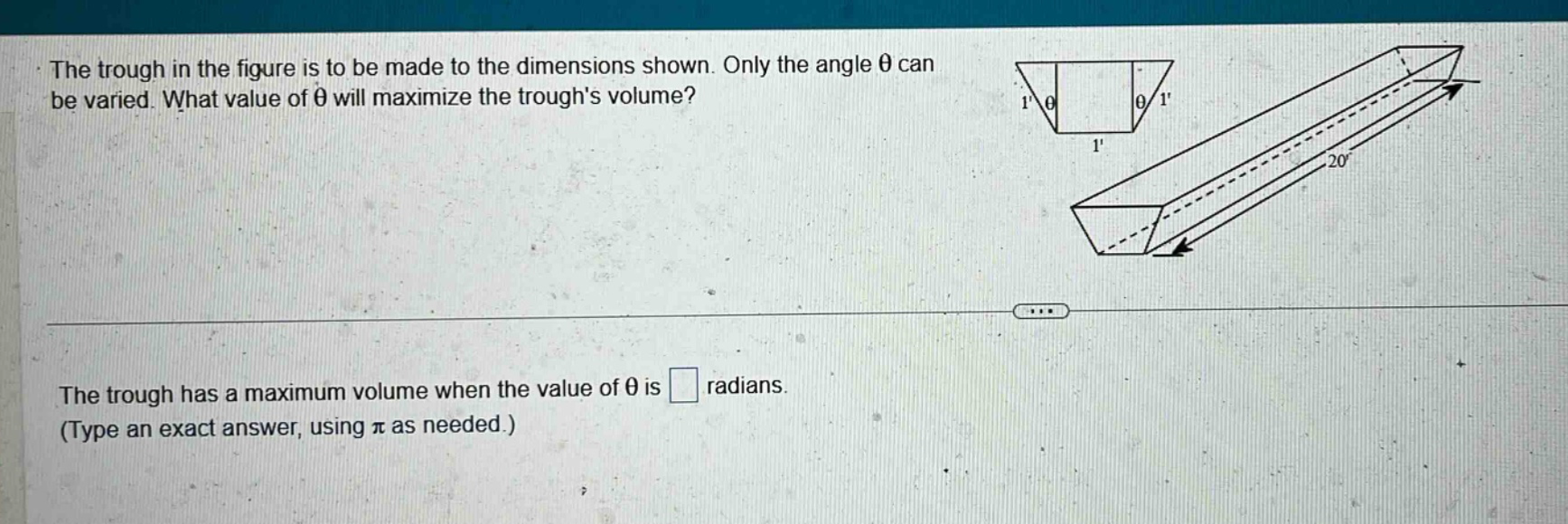
the trough in the figure is to be made to the dimensions shown. only the angle θ can be varied. what value of θ will maximize the troughs volume? the trough has a maximum volume when the value of θ is radians. (type an exact answer, using π as needed.)
Answer
Explanation:
Step1: Find the cross - sectional area formula
The cross - section of the trough is a trapezoid. The lengths of the parallel sides of the trapezoid are (b_1 = 1) and (b_2=1 + 2\sin\theta), and the height of the trapezoid is (\cos\theta). The area of a trapezoid (A=\frac{(b_1 + b_2)h}{2}), so (A=\frac{(1+(1 + 2\sin\theta))\cos\theta}{2}=(1+\sin\theta)\cos\theta=\cos\theta+\sin\theta\cos\theta).
Step2: Find the volume formula
The length of the trough (L = 20). The volume (V=A\times L), so (V = 20(\cos\theta+\sin\theta\cos\theta)=20\cos\theta + 10\sin2\theta) (since (\sin2\theta = 2\sin\theta\cos\theta)).
Step3: Differentiate the volume function
Differentiate (V(\theta)) with respect to (\theta). (V'(\theta)=- 20\sin\theta+20\cos2\theta). Using the double - angle formula (\cos2\theta=1 - 2\sin^{2}\theta), we get (V'(\theta)=-20\sin\theta + 20(1 - 2\sin^{2}\theta)=-40\sin^{2}\theta-20\sin\theta + 20).
Step4: Set the derivative equal to zero
Set (V'(\theta)=0), so (-40\sin^{2}\theta-20\sin\theta + 20 = 0). Divide through by (- 20) to get (2\sin^{2}\theta+\sin\theta - 1=0). Let (x = \sin\theta), then (2x^{2}+x - 1=(2x - 1)(x + 1)=0).
Step5: Solve for (\sin\theta)
We have two solutions for (x=\sin\theta): (x=\sin\theta=\frac{1}{2}) or (\sin\theta=-1). Since (\theta\in(0,\frac{\pi}{2})) (physical constraints of the angle in the context of the trough), we discard (\sin\theta=-1).
Step6: Find the value of (\theta)
If (\sin\theta=\frac{1}{2}) and (\theta\in(0,\frac{\pi}{2})), then (\theta=\frac{\pi}{6}).
Answer:
(\frac{\pi}{6})