true or false, if f(7) = f(7) = 0, then x = 7 must be an inflection point. (remember to give your reasons in…
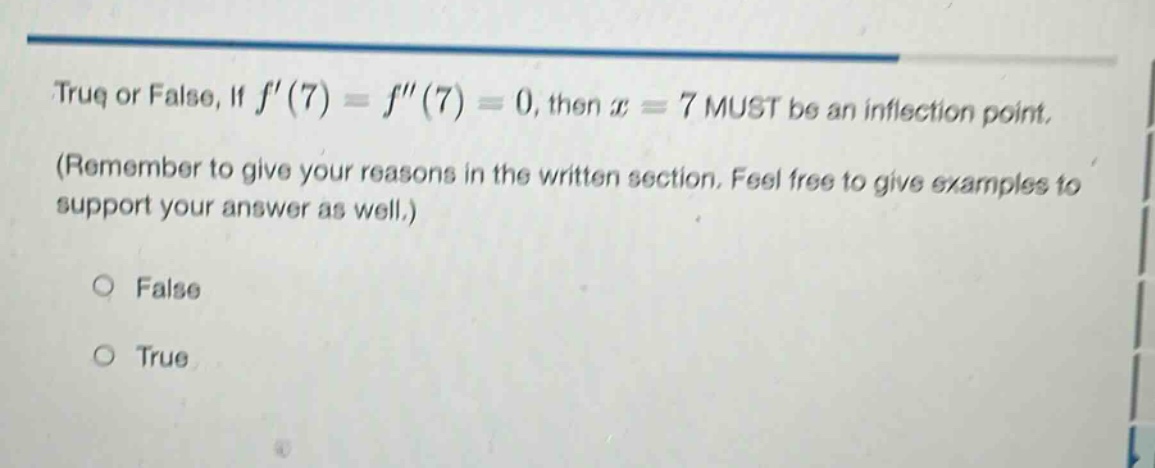
true or false, if f(7) = f(7) = 0, then x = 7 must be an inflection point. (remember to give your reasons in the written section. feel free to give examples to support your answer as well.) false true
Answer
Explanation:
Step1: Recall inflection - point definition
An inflection point is a point where the second - derivative changes sign. Just because (f''(7)=0) does not mean it changes sign at (x = 7).
Step2: Provide a counter - example
Consider the function (f(x)=(x - 7)^4). First, find the first - derivative using the power rule ((u^n)^\prime=nu^{n - 1}u^\prime). Let (u=x - 7), then (f^\prime(x)=4(x - 7)^3). And (f^\prime(7)=4(7 - 7)^3 = 0). Second, find the second - derivative: (f''(x)=12(x - 7)^2). And (f''(7)=12(7 - 7)^2=0). But (f''(x)=12(x - 7)^2\geq0) for all (x), so the second - derivative does not change sign at (x = 7), and (x = 7) is not an inflection point.
Answer:
False