true or false (mean value theorem): for the function f(x) = 2x/7 + √x on the interval 0,9. if f(c) =…
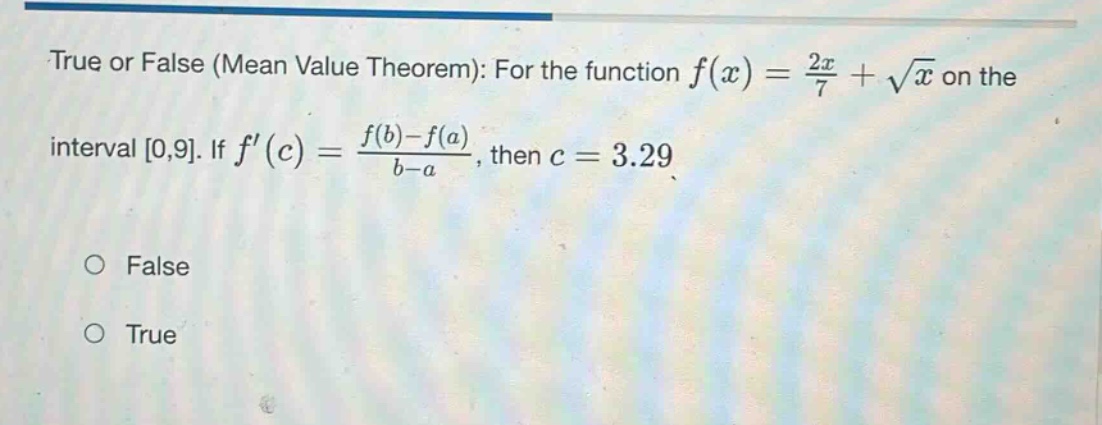
true or false (mean value theorem): for the function f(x) = 2x/7 + √x on the interval 0,9. if f(c) = (f(b)-f(a))/(b - a), then c = 3.29 false true
Answer
Explanation:
Step1: Find the derivative of (f(x))
First, rewrite (f(x)=\frac{2x}{7}+x^{\frac{1}{2}}). Using the power - rule ((x^n)^\prime = nx^{n - 1}), (f^\prime(x)=\frac{2}{7}+\frac{1}{2\sqrt{x}}).
Step2: Calculate (f(b)-f(a)) and (\frac{f(b)-f(a)}{b - a})
Here (a = 0), (b = 9). (f(9)=\frac{2\times9}{7}+\sqrt{9}=\frac{18}{7}+3=\frac{18 + 21}{7}=\frac{39}{7}), (f(0)=0). Then (\frac{f(9)-f(0)}{9 - 0}=\frac{\frac{39}{7}-0}{9}=\frac{39}{7\times9}=\frac{13}{21}).
Step3: Solve for (c)
Set (f^\prime(c)=\frac{13}{21}), so (\frac{2}{7}+\frac{1}{2\sqrt{c}}=\frac{13}{21}). Subtract (\frac{2}{7}=\frac{6}{21}) from both sides: (\frac{1}{2\sqrt{c}}=\frac{13}{21}-\frac{6}{21}=\frac{7}{21}=\frac{1}{3}). Cross - multiply to get (2\sqrt{c}=3), then (\sqrt{c}=\frac{3}{2}), and (c=\frac{9}{4}=2.25\neq3.29).
Answer:
False