it turns out that the sine and cosine functions can be used to model fluctuations in weather throughout the…
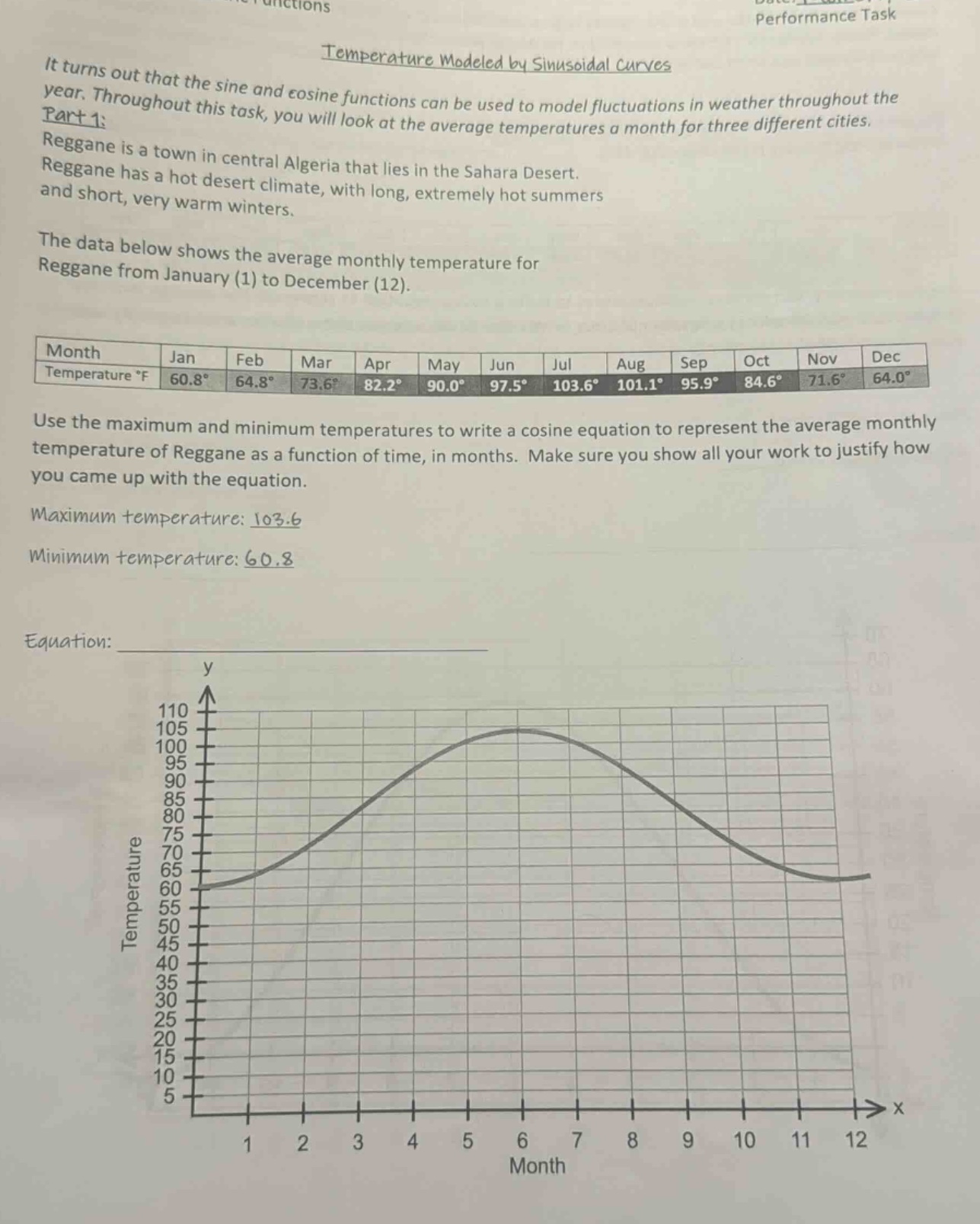
it turns out that the sine and cosine functions can be used to model fluctuations in weather throughout the year. throughout this task, you will look at the average temperatures a month for three different cities. part 1: reggane is a town in central algeria that lies in the sahara desert. reggane has a hot desert climate, with long, extremely hot summers and short, very warm winters. the data below shows the average monthly temperature for reggane from january (1) to december (12). month jan feb mar apr may jun jul aug sep oct nov dec temperature °f 60.8° 64.8° 73.6° 82.2° 90.0° 97.5° 103.6° 101.1° 95.9° 84.6° 71.6° 64.0° use the maximum and minimum temperatures to write a cosine equation to represent the average monthly temperature of reggane as a function of time, in months. make sure you show all your work to justify how you came up with the equation. maximum temperature: 103.6 minimum temperature: 60.8 equation:
Answer
Explanation:
Step1: Calculate the amplitude
The amplitude $A$ of a cosine - function $y = A\cos(B(x - C))+D$ is given by $A=\frac{\text{Max}-\text{Min}}{2}$. Here, $\text{Max}=103.6$ and $\text{Min}=60.8$. So, $A=\frac{103.6 - 60.8}{2}=\frac{42.8}{2}=21.4$.
Step2: Calculate the vertical shift
The vertical shift $D$ is the average of the maximum and minimum values. $D=\frac{\text{Max}+\text{Min}}{2}=\frac{103.6 + 60.8}{2}=\frac{164.4}{2}=82.2$.
Step3: Calculate the period and $B$ - value
The period of the function is $T = 12$ (months in a year). For a cosine function $y = A\cos(B(x - C))+D$, the period $T=\frac{2\pi}{B}$. Since $T = 12$, then $B=\frac{2\pi}{T}=\frac{2\pi}{12}=\frac{\pi}{6}$.
Step4: Determine the phase - shift
Assume the maximum occurs at $x = 7$ (July). For the basic cosine function $y=\cos(x)$ which has a maximum at $x = 0$, the phase - shift $C$ is such that when $x = 7$, the argument of the cosine function is $0$. For $y = A\cos(B(x - C))+D$, when $x = 7$, $B(x - C)=0$. Substituting $B=\frac{\pi}{6}$, we get $\frac{\pi}{6}(7 - C)=0$, so $C = 7$.
The cosine equation is $y=21.4\cos\left(\frac{\pi}{6}(x - 7)\right)+82.2$.
Answer:
$y = 21.4\cos\left(\frac{\pi}{6}(x - 7)\right)+82.2$