tutorial exercise\nfind a power series representation for the function. determine the interval of…
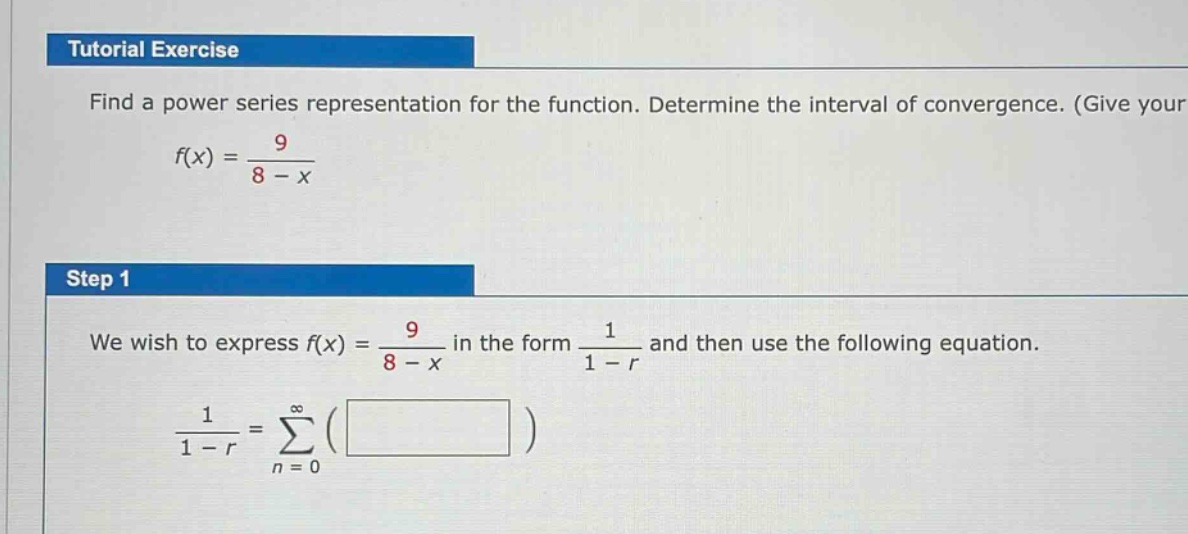
tutorial exercise\nfind a power series representation for the function. determine the interval of convergence. (give your\nf(x) = 9 / (8 - x)\nstep 1\nwe wish to express f(x) = 9 / (8 - x) in the form 1 / (1 - r) and then use the following equation.\n1 / (1 - r) = ∑(from n = 0 to ∞) ( )
Answer
Explanation:
Step1: Rewrite the function
We rewrite $f(x)=\frac{9}{8 - x}$ as $f(x)=\frac{9}{8}\cdot\frac{1}{1-\frac{x}{8}}$. We know that the geometric - series formula is $\frac{1}{1 - r}=\sum_{n = 0}^{\infty}r^{n}$, where $|r|\lt1$. Here $r=\frac{x}{8}$.
Step2: Find the power - series representation
Substituting $r = \frac{x}{8}$ into the geometric - series formula, we get $f(x)=\frac{9}{8}\sum_{n = 0}^{\infty}(\frac{x}{8})^{n}=\sum_{n = 0}^{\infty}\frac{9}{8^{n + 1}}x^{n}$.
Step3: Determine the interval of convergence
For the geometric series $\sum_{n = 0}^{\infty}r^{n}$ to converge, we need $|r|\lt1$. Since $r=\frac{x}{8}$, we have $|\frac{x}{8}|\lt1$. Solving the inequality $|\frac{x}{8}|\lt1$ gives $|x|\lt8$, or $- 8\lt x\lt8$. We need to check the endpoints: When $x=-8$, $f(x)=\sum_{n = 0}^{\infty}\frac{9}{8^{n + 1}}(-8)^{n}=\sum_{n = 0}^{\infty}\frac{9(-1)^{n}}{8}$, which diverges (it is an alternating non - zero constant series). When $x = 8$, $f(x)=\sum_{n = 0}^{\infty}\frac{9}{8^{n+1}}(8)^{n}=\sum_{n = 0}^{\infty}\frac{9}{8}$, which diverges (it is a non - zero constant series).
Answer:
The power - series representation of $f(x)$ is $\sum_{n = 0}^{\infty}\frac{9}{8^{n + 1}}x^{n}$, and the interval of convergence is $(-8,8)$.