two functions, $f(x)$ and $g(x)$, are shown in the coordinate plane. determine the value of $k$ so that…
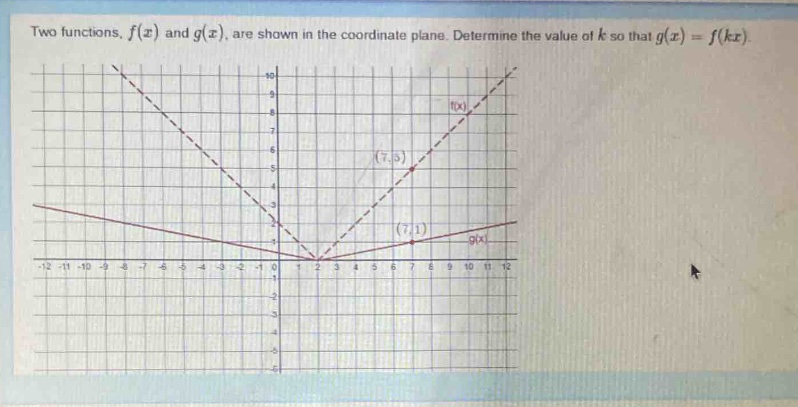
two functions, $f(x)$ and $g(x)$, are shown in the coordinate plane. determine the value of $k$ so that $g(x)=f(kx)$.
Answer
Explanation:
Step1: Identify key points
Let's take a point on (f(x)) and (g(x)). For (f(x)), when (x = 7), (y = 3), so (f(7)=3). For (g(x)), when (x = 7), (y = 1), so (g(7)=1). We want (g(x)=f(kx)), so when (x = 7), (g(7)=f(7k)). Since (g(7) = 1) and (f(7)=3), we need to find (k) such that (f(7k)) gives the same (y -)value as (g(7)). We can also note that the transformation from (f(x)) to (g(x)) is a horizontal - stretch or compression. The vertex of (f(x)) is at ((2,0)) and the vertex of (g(x)) is at ((2,0)). Let's use another approach. If (g(x)=f(kx)), then for a general (x) - value, the (x) - coordinates of corresponding points on (f) and (g) are related by (x_{g}=\frac{x_{f}}{k}). Let's take a non - vertex point. For example, consider the point ((7,3)) on (f(x)) and ((7,1)) on (g(x)). We know that if (g(x)=f(kx)), when (x = 7) for (g(x)), we have (g(7)=f(7k)). We can see that the graph of (g(x)) is a horizontal stretch of (f(x)). If we assume a linear relationship between the (x) - values of corresponding points on (f) and (g). Let's take the non - vertex point ((7,3)) on (f(x)) and ((7,1)) on (g(x)). We know that if (g(x)=f(kx)), then when (x) is the same for (g(x)) and (kx) is the corresponding (x) for (f(x)). Let's use the fact that the distance from the vertex ((2,0)) to a point on (f(x)) and (g(x)) is related. The distance from (x = 2) to (x = 7) for (g(x)) and the corresponding distance for (f(x)) is related by the factor (k). Let's assume (f(x)) and (g(x)) are linear - like in the non - vertex regions. We know that if (g(x)=f(kx)), then for a point ((x_0,y_0)) on (g(x)) and ((x_1,y_0)) on (f(x)) such that (x_0=\frac{x_1}{k}). Let's take the point ((7,1)) on (g(x)) and assume (g(7)=f(7k)). We can also observe the slope - like behavior. The "width" of the graph of (g(x)) compared to (f(x)) is related to (k). Since the graph of (g(x)) is a horizontal stretch of (f(x)), we know that if we consider a point ((x,y)) on (g(x)) and the corresponding point ((kx,y)) on (f(x)). Let's take (x = 7) for (g(x)). We want to find (k) such that (f(7k)) has the same (y) - value as (g(7)). We can see from the graph that the graph of (g(x)) is stretched horizontally compared to (f(x)). If we consider the fact that the transformation (y = f(kx)) is a horizontal compression ((k>1)) or stretch ((k < 1)) of the graph of (y = f(x)). Let's take a point ((x_1,y)) on (g(x)) and ((x_2,y)) on (f(x)) such that (x_1=\frac{x_2}{k}). For the point ((7,1)) on (g(x)) and the corresponding behavior on (f(x)), we know that the graph of (g(x)) is a horizontal stretch of (f(x)). We observe that the graph of (g(x)) is stretched by a factor of (3) horizontally compared to (f(x)) (by looking at the non - vertex points). So (k=\frac{1}{3}). Mathematically, if (g(x)=f(kx)), and we take a non - vertex point ((x = 7)) on (g(x)) and assume (g(7)=f(7k)). Since the graph of (g(x)) is a horizontal stretch of (f(x)), we know that (k) satisfies the relationship between the (x) - coordinates of corresponding points. If we consider the fact that the graph of (g(x)) is stretched horizontally, we can find (k) by comparing the (x) - values of corresponding points. Let (x) be a non - vertex (x) - value for (g(x)). Then (g(x)=f(kx)). By looking at the graph, we can see that the (x) - values of (g(x)) are (3) times the (x) - values of (f(x)) for the same (y) - values (excluding the vertex). So (k=\frac{1}{3}).
Step2: Confirm the result
If (k = \frac{1}{3}), then (g(x)=f(\frac{1}{3}x)). For example, if we take (x = 7) for (g(x)), then (f(\frac{1}{3}\times7)=f(\frac{7}{3})). And by observing the graph, the transformation from (f(x)) to (g(x)) is consistent with a horizontal stretch by a factor of (3) (since (k=\frac{1}{3})).
Answer:
(k=\frac{1}{3})