two similar - looking series are given. test each one for convergence (a) ∑(n = 1 to ∞) n / 7^n convergent…
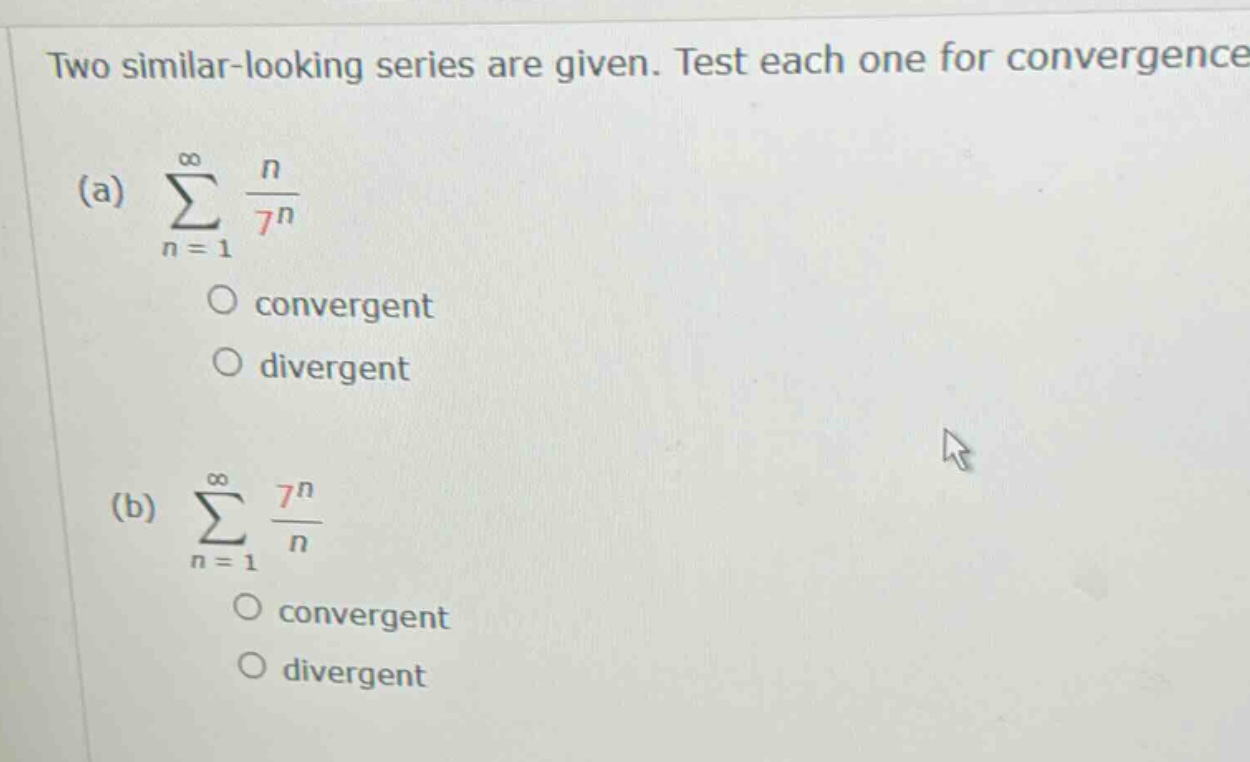
two similar - looking series are given. test each one for convergence (a) ∑(n = 1 to ∞) n / 7^n convergent divergent (b) ∑(n = 1 to ∞) 7^n / n convergent divergent
Answer
Explanation:
Step1: Apply ratio - test for (a)
Let (a_n=\frac{n}{7^n}). Then (a_{n + 1}=\frac{n+1}{7^{n + 1}}). Calculate the ratio (\left|\frac{a_{n+1}}{a_n}\right|=\left|\frac{\frac{n + 1}{7^{n+1}}}{\frac{n}{7^n}}\right|=\left|\frac{n + 1}{7^{n+1}}\times\frac{7^n}{n}\right|=\frac{n + 1}{7n}=\frac{1+\frac{1}{n}}{7}).
Step2: Find the limit as (n\to\infty) for (a)
(\lim_{n\rightarrow\infty}\left|\frac{a_{n + 1}}{a_n}\right|=\lim_{n\rightarrow\infty}\frac{1+\frac{1}{n}}{7}=\frac{1+0}{7}=\frac{1}{7}<1). By the ratio - test, the series (\sum_{n = 1}^{\infty}\frac{n}{7^n}) is convergent.
Step3: Apply the divergence - test for (b)
Let (b_n=\frac{7^n}{n}). Then (\lim_{n\rightarrow\infty}b_n=\lim_{n\rightarrow\infty}\frac{7^n}{n}). Using L'Hopital's rule (or the fact that exponential function (y = 7^n) grows faster than the linear function (y=n)), (\lim_{n\rightarrow\infty}\frac{7^n}{n}=\infty). Since (\lim_{n\rightarrow\infty}b_n\neq0), by the divergence - test, the series (\sum_{n = 1}^{\infty}\frac{7^n}{n}) is divergent.
Answer:
(a) convergent (b) divergent