which two statements are true about the function y = 12e^(-t) when t ≥ 0? as t approaches infinity, y…
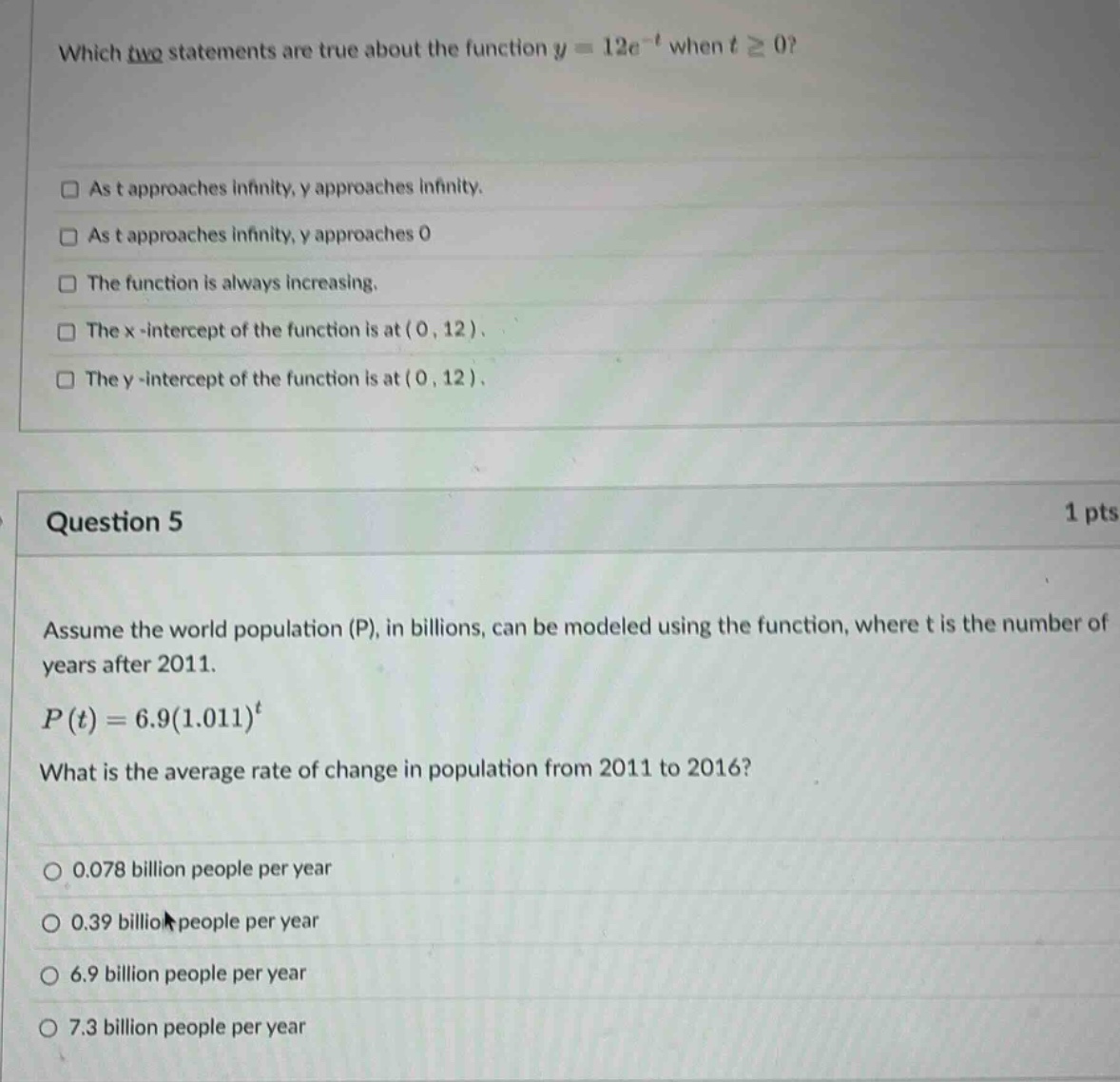
which two statements are true about the function y = 12e^(-t) when t ≥ 0? as t approaches infinity, y approaches infinity. as t approaches infinity, y approaches 0 the function is always increasing. the x - intercept of the function is at (0, 12). the y - intercept of the function is at (0, 12). question 5 1 pts assume the world population (p), in billions, can be modeled using the function, where t is the number of years after 2011. p(t)=6.9(1.011)^t what is the average rate of change in population from 2011 to 2016? 0.078 billion people per year 0.39 billion people per year 6.9 billion people per year 7.3 billion people per year
Answer
Explanation:
Step1: Analyze the function $y = 12e^{-t}$
The general form of an exponential - decay function is $y = ae^{-bt}$ where $a = 12$ and $b = 1$.
Step2: Find the limit as $t\rightarrow\infty$
We know that $\lim_{t\rightarrow\infty}e^{-t}=\lim_{t\rightarrow\infty}\frac{1}{e^{t}} = 0$. So, $\lim_{t\rightarrow\infty}y=\lim_{t\rightarrow\infty}12e^{-t}=0$.
Step3: Determine the derivative of $y = 12e^{-t}$
Using the chain - rule, if $y = 12e^{-t}$, then $y^\prime=- 12e^{-t}<0$ for $t\geq0$. So the function is decreasing.
Step4: Find the $y$ - intercept
To find the $y$ - intercept, set $t = 0$. When $t = 0$, $y=12e^{0}=12$. The $y$ - intercept is at $(0,12)$. The function $y = 12e^{-t}$ has no $x$ - intercept since $12e^{-t}>0$ for all $t\geq0$.
For the population function $P(t)=6.9(1.011)^{t}$:
Step1: Calculate $P(0)$ (corresponding to 2011)
When $t = 0$ (2011), $P(0)=6.9(1.011)^{0}=6.9$.
Step2: Calculate $P(5)$ (corresponding to 2016)
When $t = 5$ (2016), $P(5)=6.9(1.011)^{5}$. Using the formula $a(1 + r)^{n}$, where $a = 6.9$, $r=0.011$, and $n = 5$. $P(5)=6.9\times1.05627=7.288263$.
Step3: Calculate the average rate of change
The average rate of change formula is $\frac{P(5)-P(0)}{5 - 0}=\frac{7.288263 - 6.9}{5}=\frac{0.388263}{5}=0.0776526\approx0.078$.
Answer:
For the function $y = 12e^{-t}$: As $t$ approaches infinity, $y$ approaches $0$; The $y$ - intercept of the function is at $(0,12)$. For the population function: 0.078 billion people per year