type an integer or decimal rounded to three decimal places as needed.) why can the intermediate value…
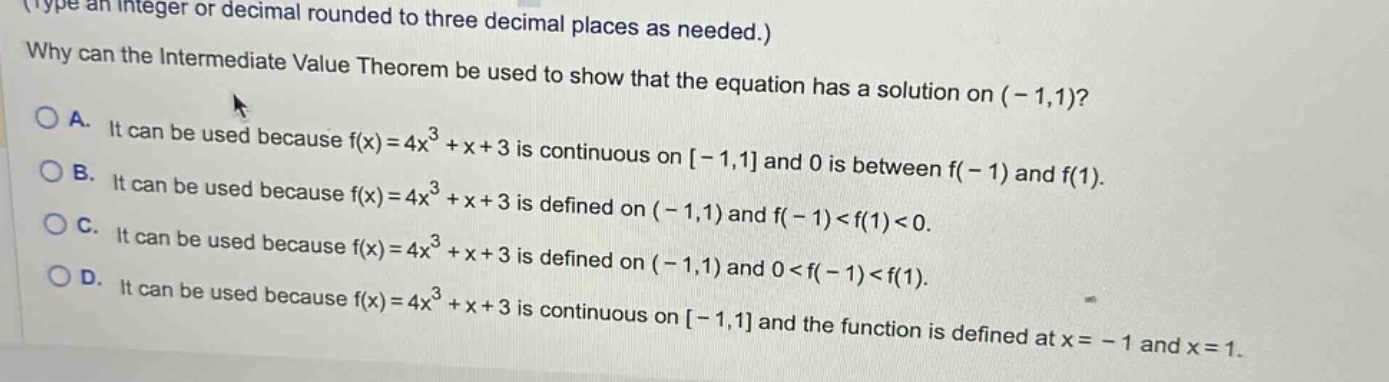
type an integer or decimal rounded to three decimal places as needed.) why can the intermediate value theorem be used to show that the equation has a solution on (-1,1)? a. it can be used because f(x)=4x³ +x + 3 is continuous on -1,1 and 0 is between f(-1) and f(1). b. it can be used because f(x)=4x³ +x + 3 is defined on (-1,1) and f(-1)<f(1)<0. c. it can be used because f(x)=4x³ +x + 3 is defined on (-1,1) and 0<f(-1)<f(1). d. it can be used because f(x)=4x³ +x + 3 is continuous on -1,1 and the function is defined at x=-1 and x = 1.
Answer
Answer:
A. It can be used because $f(x)=4x^{3}+x + 3$ is continuous on $[-1,1]$ and $0$ is between $f(-1)$ and $f(1)$.
Explanation:
Step1: Recall Intermediate Value Theorem
The theorem states that if $y = f(x)$ is continuous on a closed - interval $[a,b]$, and $k$ is a number between $f(a)$ and $f(b)$, then there exists at least one number $c$ in the open - interval $(a,b)$ such that $f(c)=k$.
Step2: Analyze the function
The function $f(x)=4x^{3}+x + 3$ is a polynomial function. Polynomial functions are continuous everywhere, so $f(x)$ is continuous on $[-1,1]$.
Step3: Check the condition for the theorem
We want to show that the equation $4x^{3}+x + 3 = 0$ has a solution in $(-1,1)$. We need to check if $0$ is between $f(-1)$ and $f(1)$. Calculate $f(-1)=4(-1)^{3}+(-1)+3=-4 - 1+3=-2$ and $f(1)=4(1)^{3}+1 + 3=4 + 1+3=8$. Since $-2<0<8$, $0$ is between $f(-1)$ and $f(1)$. So the Intermediate - Value Theorem can be used.