(type your answer in interval notation.) determine the horizontal asymptote of f(x)=4^(-x)-2. select the…
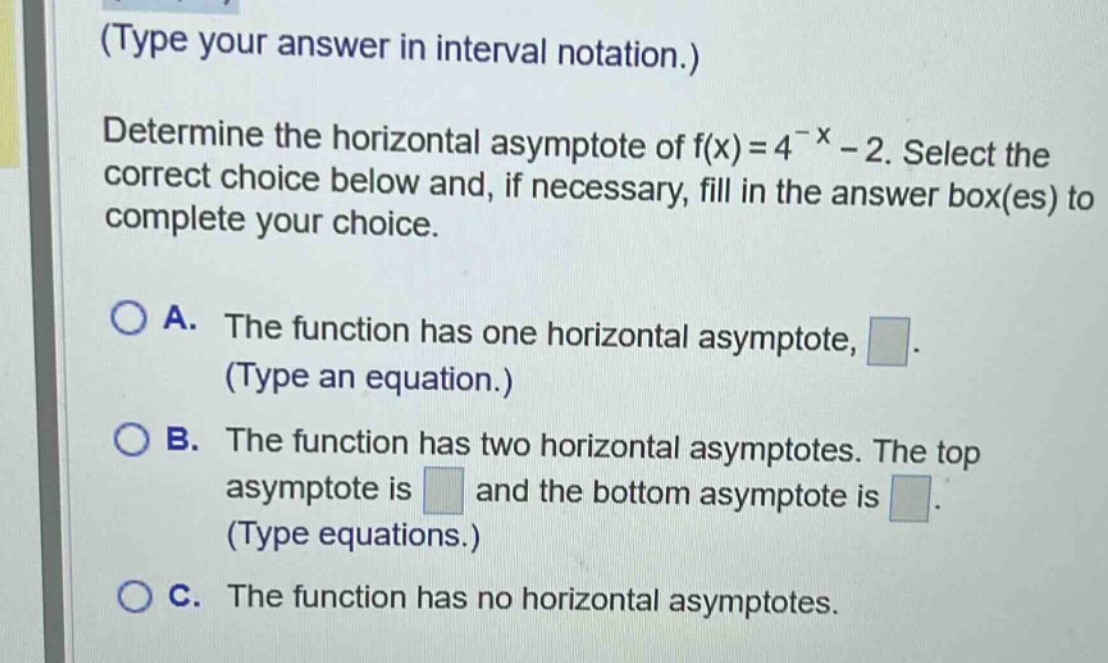
(type your answer in interval notation.) determine the horizontal asymptote of f(x)=4^(-x)-2. select the correct choice below and, if necessary, fill in the answer box(es) to complete your choice. a. the function has one horizontal asymptote, (type an equation.) b. the function has two horizontal asymptotes. the top asymptote is and the bottom asymptote is (type equations.) c. the function has no horizontal asymptotes.
Answer
Explanation:
Step1: Recall the definition of horizontal asymptote
We find the limit as $x\to\pm\infty$. For $y = 4^{-x}-2=\left(\frac{1}{4}\right)^{x}-2$.
Step2: Calculate $\lim_{x\to+\infty}f(x)$
As $x\to+\infty$, we know that for an exponential function $y = a^{x}$ where $0 < a<1$ (here $a=\frac{1}{4}$), $\lim_{x\to+\infty}a^{x}=0$. So $\lim_{x\to+\infty}\left(\frac{1}{4}\right)^{x}-2=0 - 2=-2$.
Step3: Calculate $\lim_{x\to-\infty}f(x)$
As $x\to-\infty$, $\left(\frac{1}{4}\right)^{x}=4^{|x|}\to+\infty$. So the limit as $x\to-\infty$ does not exist as a finite - value.
Answer:
A. The function has one horizontal asymptote, $y = - 2$.