unit 3 - section 1.5 question 3 of 10 (1 point) | question attempt: 1 of unlimited part 1 of 10 (a) as…
unit 3 - section 1.5 question 3 of 10 (1 point) | question attempt: 1 of unlimited part 1 of 10 (a) as x→−∞,f(x)→2. part 2 of 10 (b) as x→3−,f(x)→−∞. part 3 of 10 (c) as x→3+,f(x)→∞. part 4 of 10 (d) as x→∞,f(x)→2. part 5 of 10 is the graph increasing over at least one interval? no is the graph decreasing over at least one interval? yes part: 5 / 10 part 6 of 10 (e) the graph is decreasing over the interval(s) (−∞,3) try again 0,0 0,0 (0,0
Answer
Explanation:
Step1: Analyze end - behavior
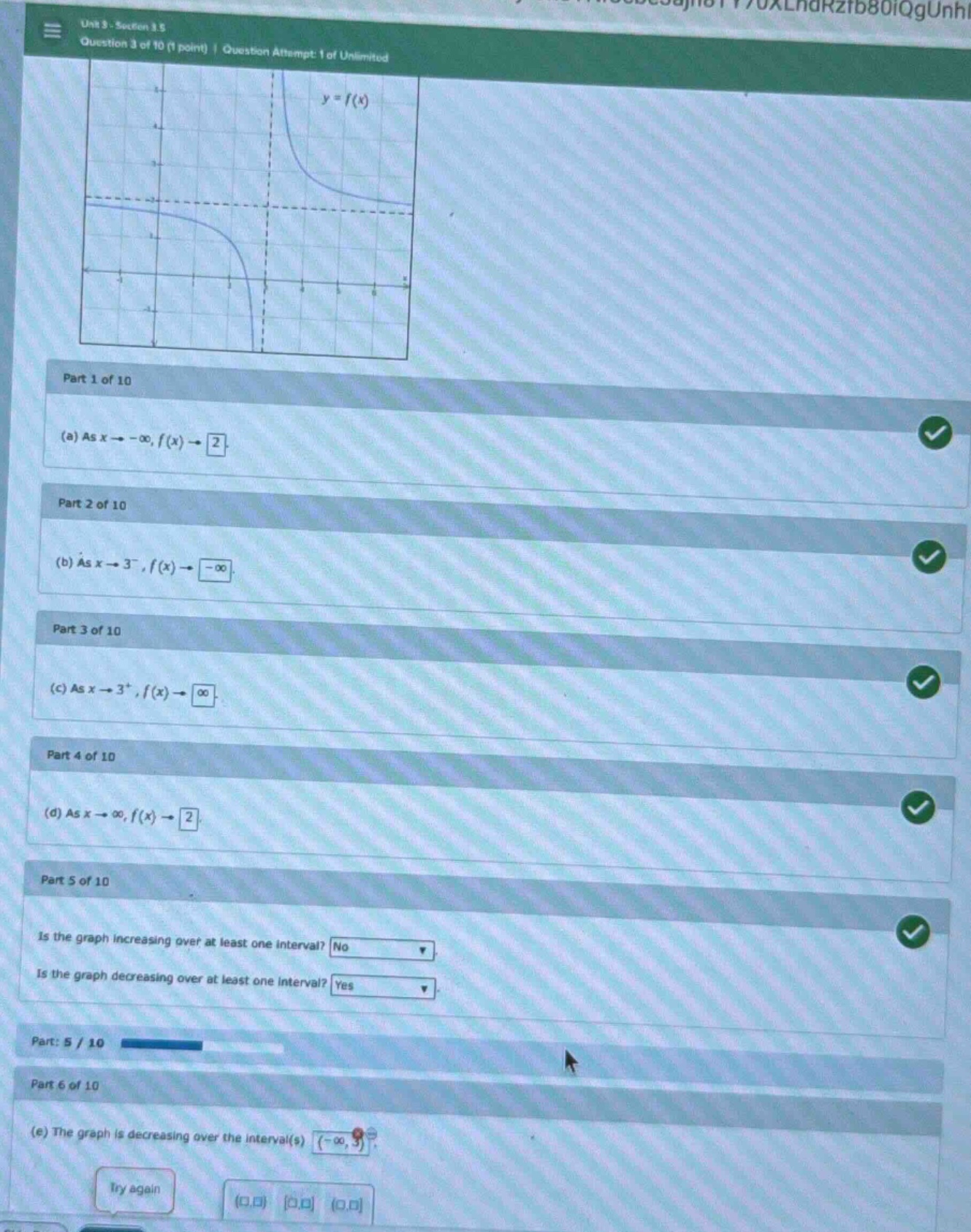
As (x\to-\infty), we look at the left - hand side of the graph. The graph approaches (y = 2), so (f(x)\to2).
Step2: Analyze left - hand limit at (x = 3)
As (x\to3^{-}), we approach (x = 3) from the left. The graph goes down towards negative infinity, so (f(x)\to-\infty).
Step3: Analyze right - hand limit at (x = 3)
As (x\to3^{+}), we approach (x = 3) from the right. The graph goes up towards positive infinity, so (f(x)\to\infty).
Step4: Analyze end - behavior
As (x\to\infty), we look at the right - hand side of the graph. The graph approaches (y = 2), so (f(x)\to2).
Step5: Analyze increasing and decreasing intervals
The graph has no interval where it is increasing (no part where (y) values go up as (x) values increase), but it is decreasing for (x\in(-\infty,3)\cup(3,\infty)) ( (y) values go down as (x) values increase in these intervals).
Answer:
(a) 2 (b) (-\infty) (c) (\infty) (d) 2 (e) ((-\infty,3)\cup(3,\infty))