unit 3 - section 3.5 question 3 of 10 (1 point) | question attempt: 1 of unlimited part 1 of 10 (a) as…
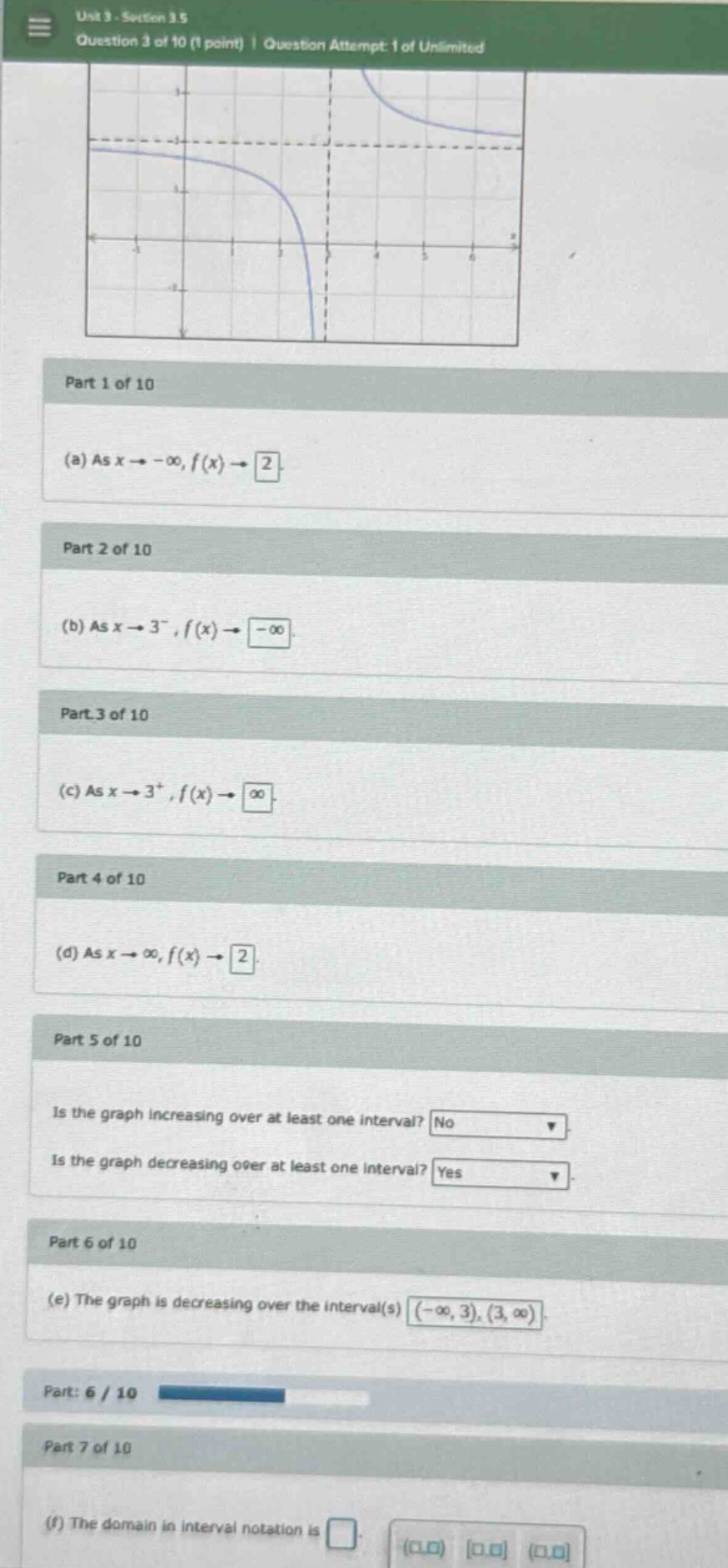
unit 3 - section 3.5 question 3 of 10 (1 point) | question attempt: 1 of unlimited part 1 of 10 (a) as x→−∞,f(x)→2. part 2 of 10 (b) as x→3−,f(x)→−∞. part 3 of 10 (c) as x→3+,f(x)→∞. part 4 of 10 (d) as x→∞,f(x)→2. part 5 of 10 is the graph increasing over at least one interval? no is the graph decreasing over at least one interval? yes part 6 of 10 (e) the graph is decreasing over the interval(s) (−∞,3),(3,∞). part: 6 / 10 part 7 of 10 (f) the domain in interval notation is (□,□) □,□ (□,□
Answer
Explanation:
Step1: Analyze horizontal - asymptote as x→−∞
As (x\to-\infty), by observing the graph, the function approaches (y = 2).
Step2: Analyze left - hand limit as x→3
As (x\to3^{-}), the function values go downwards without bound, so (f(x)\to-\infty).
Step3: Analyze right - hand limit as x→3
As (x\to3^{+}), the function values go upwards without bound, so (f(x)\to\infty).
Step4: Analyze horizontal - asymptote as x→∞
As (x\to\infty), by observing the graph, the function approaches (y = 2).
Step5: Analyze increasing and decreasing intervals
The graph is decreasing for (x<3) and (x > 3), and there is no interval where it is increasing.
Step6: Write the decreasing intervals
The graph is decreasing over ((-\infty,3)) and ((3,\infty)).
Step7: Find the domain
The function is defined for all real numbers except (x = 3). So the domain in interval notation is ((-\infty,3)\cup(3,\infty)).
Answer:
(a) 2 (b) (-\infty) (c) (\infty) (d) 2 (e) No; Yes (f) ((-\infty,3)\cup(3,\infty))