use algebra and the properties of limits as needed to find the given limit. if the limit does not exist, say…
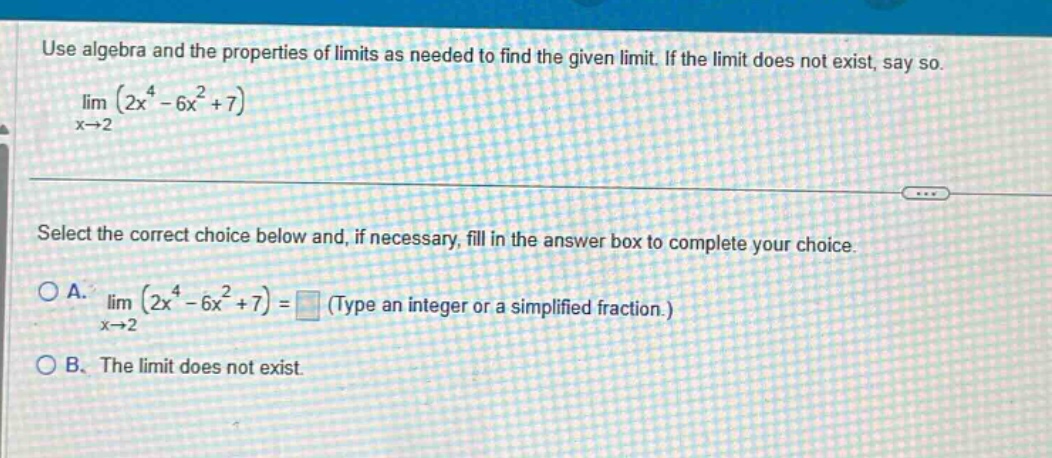
use algebra and the properties of limits as needed to find the given limit. if the limit does not exist, say so. lim (2x^4 - 6x^2 + 7) x→2 select the correct choice below and, if necessary, fill in the answer box to complete your choice. a. lim (2x^4 - 6x^2 + 7) = (type an integer or a simplified fraction.) x→2 b. the limit does not exist.
Answer
Explanation:
Step1: Apply limit - sum rule
$\lim_{x\rightarrow a}(f(x)+g(x))=\lim_{x\rightarrow a}f(x)+\lim_{x\rightarrow a}g(x)$. So, $\lim_{x\rightarrow 2}(2x^{4}-6x^{2}+7)=\lim_{x\rightarrow 2}(2x^{4})-\lim_{x\rightarrow 2}(6x^{2})+\lim_{x\rightarrow 2}(7)$.
Step2: Apply constant - multiple rule
$\lim_{x\rightarrow a}(cf(x)) = c\lim_{x\rightarrow a}f(x)$. Then, $\lim_{x\rightarrow 2}(2x^{4}) = 2\lim_{x\rightarrow 2}(x^{4})$, $\lim_{x\rightarrow 2}(6x^{2})=6\lim_{x\rightarrow 2}(x^{2})$.
Step3: Apply power - rule
$\lim_{x\rightarrow a}(x^{n})=a^{n}$. So, $2\lim_{x\rightarrow 2}(x^{4})=2\times2^{4}$, $6\lim_{x\rightarrow 2}(x^{2}) = 6\times2^{2}$, and $\lim_{x\rightarrow 2}(7)=7$.
Step4: Calculate each term
$2\times2^{4}=2\times16 = 32$, $6\times2^{2}=6\times4 = 24$.
Step5: Combine the terms
$32-24 + 7=15$.
Answer:
A. $\lim_{x\rightarrow 2}(2x^{4}-6x^{2}+7)=15$