use algebra and the properties of limits as needed to find the given limit. if the limit does not exist, say…
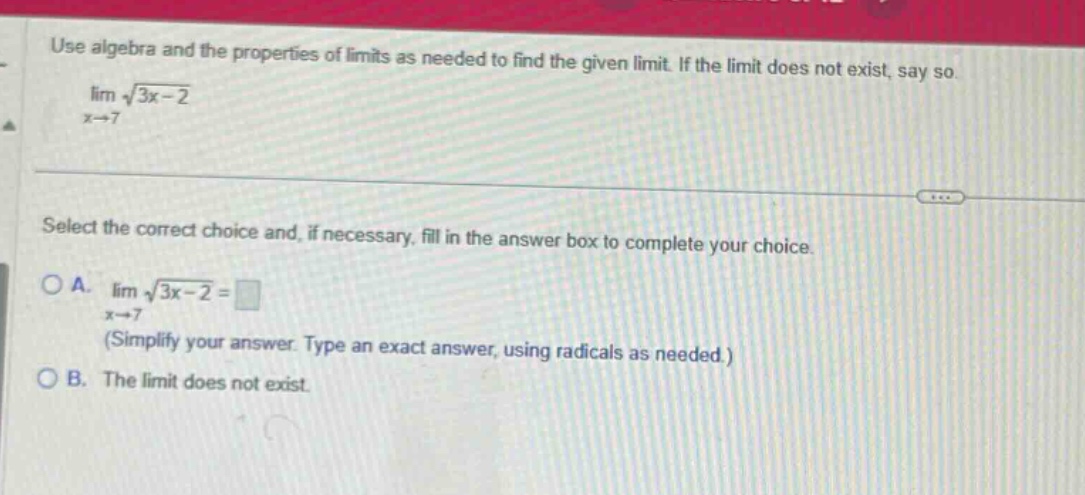
use algebra and the properties of limits as needed to find the given limit. if the limit does not exist, say so. lim(x→7) √(3x - 2) select the correct choice and, if necessary, fill in the answer box to complete your choice. o a. lim(x→7) √(3x - 2)= (simplify your answer. type an exact answer, using radicals as needed.) o b. the limit does not exist.
Answer
Explanation:
Step1: Substitute x = 7
We use the direct - substitution property of limits for the function (y = \sqrt{3x - 2}). Substitute (x = 7) into (3x-2). [3x-2=3\times7 - 2] [=21 - 2=19]
Step2: Find the limit
Since the function (y=\sqrt{3x - 2}) is continuous at (x = 7) (because the expression under the square - root is non - negative for (x = 7)), we have (\lim_{x\rightarrow7}\sqrt{3x - 2}=\sqrt{\lim_{x\rightarrow7}(3x - 2)}). (\lim_{x\rightarrow7}\sqrt{3x - 2}=\sqrt{19})
Answer:
A. (\lim_{x\rightarrow7}\sqrt{3x - 2}=\sqrt{19})