use the appropriate limit laws and theorems to determine the limit of the sequence. a_n=(1 + 3/n^2)^n (use…
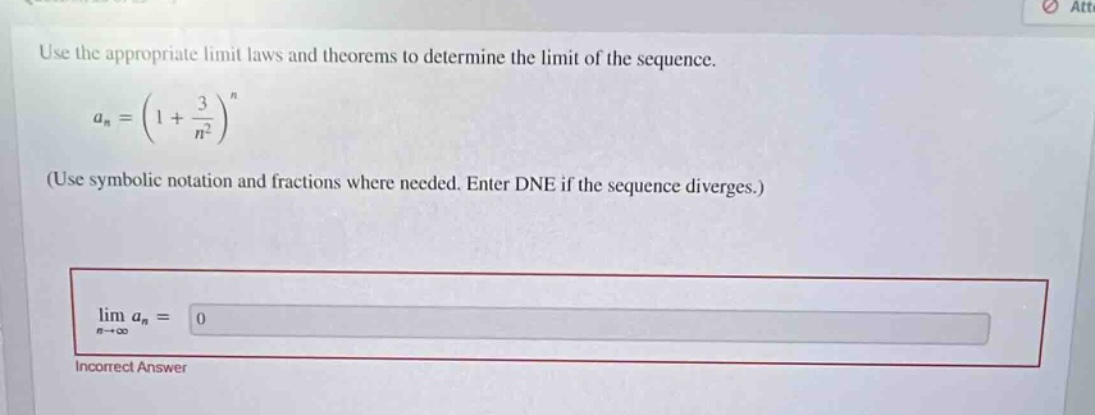
use the appropriate limit laws and theorems to determine the limit of the sequence. a_n=(1 + 3/n^2)^n (use symbolic notation and fractions where needed. enter dne if the sequence diverges.) lim a_n = 0 incorrect answer
Answer
Explanation:
Step1: Recall the limit - related theorem
We know the well - known limit formula $\lim_{n\rightarrow\infty}(1 + \frac{x}{n})^n=e^x$. For the sequence $a_n=(1+\frac{3}{n^2})^n$, we use the following approach. Let $y = (1+\frac{3}{n^2})^n$. Then, take the natural logarithm of both sides: $\ln y=n\ln(1 + \frac{3}{n^2})$.
Step2: Use the approximation for $\ln(1 + x)$
When $x\rightarrow0$, $\ln(1 + x)\sim x$. As $n\rightarrow\infty$, $\frac{3}{n^2}\rightarrow0$. So, $\ln(1+\frac{3}{n^2})\sim\frac{3}{n^2}$ when $n\rightarrow\infty$. Then $\ln y=n\ln(1 + \frac{3}{n^2})\sim n\times\frac{3}{n^2}=\frac{3}{n}$.
Step3: Find the limit of $\ln y$
We find $\lim_{n\rightarrow\infty}\ln y=\lim_{n\rightarrow\infty}\frac{3}{n}=0$.
Step4: Find the limit of $y$
Since $y = e^{\ln y}$, and $\lim_{n\rightarrow\infty}\ln y = 0$, by the continuity of the exponential function $y = e^x$, we have $\lim_{n\rightarrow\infty}y=\lim_{n\rightarrow\infty}(1+\frac{3}{n^2})^n=e^0 = 1$.
Answer:
$1$